
“The Gospel of Thomas reads like an incredible kind of Rorschach of your own spiritual journey. It’s amazing.” Cynthia Bourgeault
Discovery and Impact
“Among all the astonishing documents accidentally—or fatefully—unearthed in 1945 near the desert village of Nag Hammadi in Upper Egypt, the Gospel of Thomas has made the greatest impact on our understanding of Christianity. Nearly two thousand years after the suppression of these so-called heresies, we now suddenly have the opportunity to look directly at aspects of their teachings instead of seeing them largely through the eyes of their enemies. But although the texts themselves can now be directly seen for the first time in nearly two thousand years, really to see them is a task that invites us to something much more demanding and joyous than simply reading them off the pages of ancient scrolls. In this document the very first words of Jesus, here called by the Aramaic name Yeshua, are these: ‘Whoever lives the interpretation of these words will no longer taste death.’ Is this merely a figure of speech? Or do these words speak to some kind of knowledge and knowing that have an action upon the very flesh and blood of a human being?” Jacob Needleman, Forward, Jean-Yves Leloup, The Gospel of Thomas, Inner Traditions, 2005.
Unified Teaching, Not Scattered Sayings
“In the canonical Gospels the teachings are put within a narrative framework which necessarily puts its attention on the life of Jesus and the meaning of the life of Jesus. Whereas within the Gospel of Thomas you have them within a framework that really is focused around the teaching of Jesus. And I say very clearly the teaching, not the teachings, because what really distinguishes Thomas’ work is the conviction that this is a unified teaching. It has a core theme, it has a place it’s going, it has a vision of how it’s going to get there.” Cynthia Bourgeault, The Divine Exchange, 1:15disc2 track9
Synchronic Symphony
I made a series of startling discoveries. Here is what I found: Not only did Thomas appear to be carefully and sequentially arranged (but without a narrative structure per se), it was intended to raise and then later answer questions in the reader’s mind in an almost dialogical way. It was as if I was having a conversation not only with the text, but with the “living Master” behind the text. Essentially I saw it not only to be dialogical, but also to be a synchronic text—each logion once read was to remain “in play” so that the next logia could be properly understood. The whole Gospel was more like an orchestra playing a symphony of meaning than it was a story being told diachronically as in the narrative style of the canonical Gospels. The Gospel of Thomas was a wisdom text expressed in a sapiential way meant for those who wished to be in a dialogue with its living Master. I also found that if I kept in mind the questions which each saying raised, later logia would often directly address those very questions while also raising new ones. —Lynn C. Bauman, Introduction to In Trouble and Wonder: A Spiritual Commentary on the Gospel of Thomas (Praxis 2014)
The Gospel of Thomas reads like an incredible kind of Rorschach of your own spiritual journey. It’s amazing. —Cynthia Bourgeault, 37:50 The Heart of Centering Prayer 2016 Part 3 of 4
Ancient Transmission, Timeless Wisdom
To the extent that you have faith, have confidence or reason to suspect that the Gospel of Thomas is not only a true transmission of Jesus but probably actually the earliest transmission of Jesus at least in its core, then you can say that Jesus knew what Gurdjieff knew and this is the thing that electrified me and still electrifies me. —Cynthia Bourgeault, Claymont 2012 Gurdjieff for Christian Contemplatives, ~28:00 19 Saturday Morning Teaching
The Imperative to Manifest
Remember the Gospel of Thomas says in one of its most howling passages, if you bring forth what is within you, what you bring forth will save you. If you fail to bring forth what is within you, that which you fail to bring forth will destroy you. In other words, we come into this planet with a destiny. Manifest, manifest, manifest. —Cynthia Bourgeault, Stonington June 2016 Teilhard, 16:17 2016-06-11d Teilhard Session 3 Saturday Morning Part 2
Tools for Maturation
I really believe that some of the resources that Thomas has seeded into this material that he’s left us are the tools to help us grow up, to mature as contemplatives, so that without losing that ground in silence and impartiality, we can be in the world with a much stronger presence and hold the post of, at the very least, holding that highest note of what human beings are capable of, and beyond that, holding that creative, open space of third force in which something new might genuinely arise. We can’t predict it. We can’t anticipate it. —Cynthia Bourgeault, Silence as Presence Feb 2025, 7:05 09 Silence Tues am teaching
Logion 1
I who write this am Thomas, the Double, the Twin.
Yeshua, the Living Master spoke,
and his secret sayings I have written down.
I assure you, whoever grasps their meaning
will not know the taste of death.
Logion 9
Yeshua says...
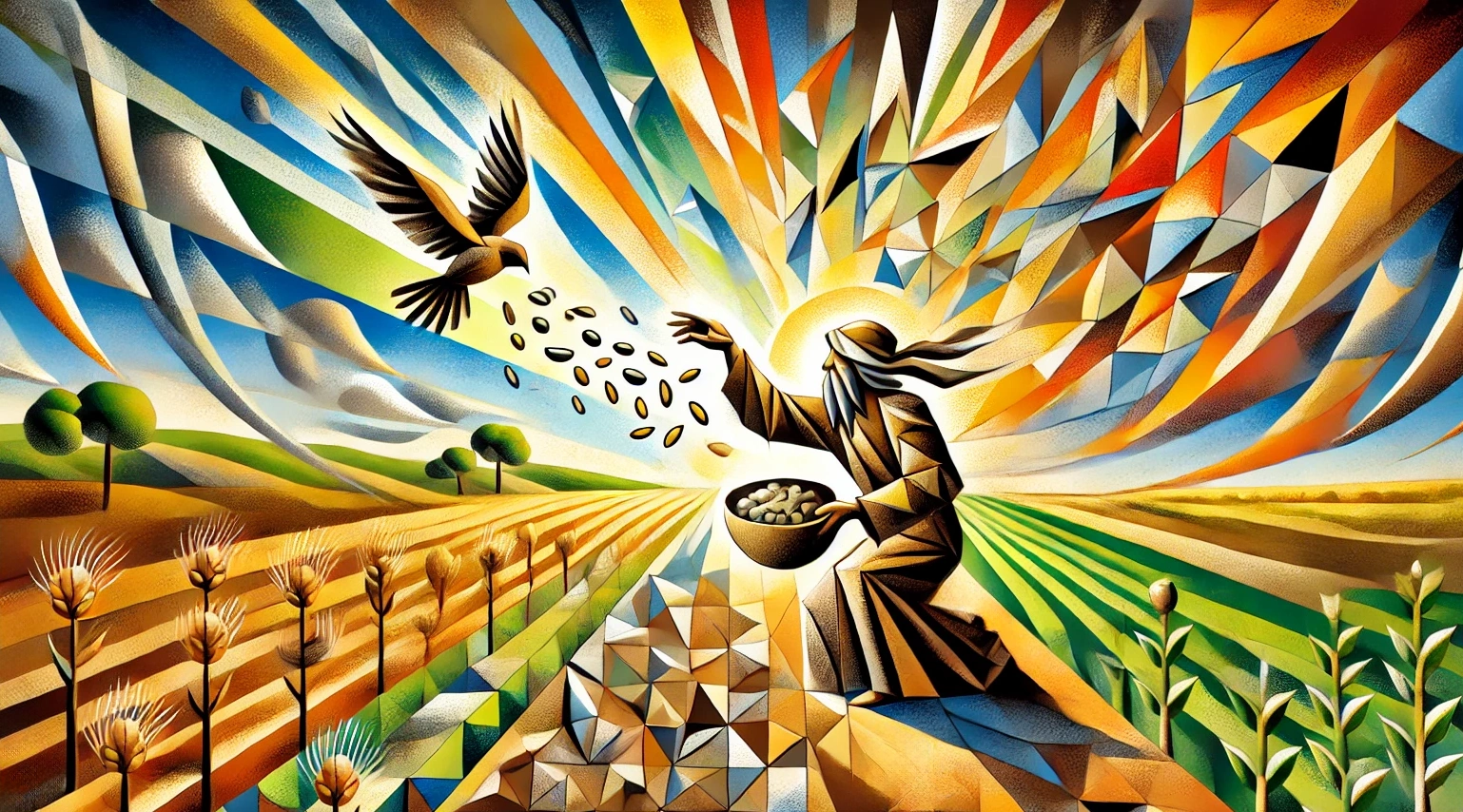
A farmer went out to plant,
scattering seed everywhere.
Some seeds fell on the surface of the road,
and the birds came and ate them.
Others fell on rocky ground
and could not take root in the earth,
and so never germinated.
Still other seed fell among the weeds and brambles,
which choked it out and insects devoured.
Some, however, fell onto fertile soil
which produced fruit of high quality,
yielding as much as sixty
and one-hundred and twenty percent.
Read more Impressions featuring the Gospel of Thomas.
Quotations from the Gospel of Thomas are from Lynn C Bauman, Ward J Bauman, Cynthia Bourgeault, The Luminous Gospels (Praxis 2008)




I took an online course lead by Cynthia on the Book of Thomas. I was grateful for Cynthia’s teaching as the Book is written in a way that challenged my mind, brought another level of wonderment to my heart and such sensation in this body. I’d take that course all over again!
That sounds wonderful. Sounds like Cynthia! WB
thank you for this encouragement. I look forward to this.
Grateful for your offering today.
Good to hear from you, Rosemary! Bill
On the quote of Cynthia from Claymont 2012 Gurdjieff, what did Jesus and Gurdjieff knew??
Cynthia is speaking generically to a group of (perhaps) beginners with the Gospel of Thomas. But the path of Jesus, with poor in spirit, kenosis, acceptance, letting be, letting go of attachments, etc maps onto Gurdjieff’s voluntary suffering, letting go of identifications, etc. That’s the heart of the harmonized voices in my Impressions. Cynthia, Thomas, Gurdjieff, Maurice Nicoll, Tomberg, Jacob Boehme, are all in the same realm. The dance of active and passive. Attention and surrender. Gurdjieff’s Law of Three. Jacob Boehme’s pain is the ground of motion. All of the Impressions rippling out from one center. Bill