
What is faith? Is there a deeper meaning of faith? Maurice Nicoll and Cynthia Bourgeault offer insight.
“Faith is necessary to open a part of the mind not opened by the senses. To realize scale means to realize that there are different levels of meaning. Literal meaning is one thing, psychological or spiritual meaning is another thing—although the words used are the same. Sense and faith describe two ways of thinking, not opposites, not antagonistic, but on different levels. For without the perception of scale and levels, things are made to be opposite when they are not so, and the mind is split into ‘either’—‘or’, which leads to endless confusions and mental wrangles and miseries.” Maurice Nicoll, Psychological Commentaries, p1624-25.
“Faith is connected with the idea of transformation and so is not mere belief, on the ordinary plane. Faith, in its essential meaning, denotes a conviction, a certainty, that a higher interpretation of life exists and, as a consequence, that the transformation of Man is a possibility. The peculiar quality of faith lies in this idea, that life can only be understood and solved by the sense of something higher than Man as he is, and that Man has this possibility of becoming transformed and passing into entirely new meanings in regard to his life on earth. It is this peculiar quality that is the essence of faith and renders it utterly different from what we usually call belief. Faith, in fact, undermines all our ordinary and natural beliefs because it leads away from worldly belief and in a direction that can no longer be confirmed by natural belief and the evidence of sense. And for this reason it is defined as a seed in a man’s mind.” Maurice Nicoll, The New Man, p163.
“In all the parables about faith in the Gospels, the emphasis is laid on the fact that the approach to Christ—that is, the approach to the teaching about re-birth and the evolution of oneself—is impossible by means of the ordinary worldly thoughts and emotions. An exertion, an effort, is needed beyond what anyone would think or do ordinarily. A man does not come to the stage of inner understanding belonging to faith by means of anything outer, anything seen. To live by the seen is to live on one level of life: to live by faith is to begin to live on another. And this other level, which is eventually the re-birth of a man, once he attains it, is a definite thing, a real state, an actual possibility, to which all the ideas of faith and its Truth and knowledge can eventually lift a man. A higher level of man can only be reached through a class of knowledge and ideas that must be kept alive by continual effort, and does not correspond to anything that life confirms. A man must look away from the scene of life to reach its meaning. Faith is thus a continual inner effort, a continual altering of the mind, of the habitual ways of thought, of the habitual ways of taking everything, of habitual reactions. To act from faith is to act from beyond the range of the ideas and reasons that the sense−known side of the world has built up in everyone’s mind. On the side of love it is to will action beyond natural considerations, in the light of comparison between what one is and what lies above one, what is possible. For its direction is to another stage of a man and so another level of himself to which life cannot raise him. So through having faith, a man’s attitude to life will gradually change. He will see it no longer as the sole end. And he will no longer act always for the sake of the man that he is but for the New Man above himself, for the new possibility hidden in him.” Maurice Nicoll, The New Man, p182-183
“The idea of faith cannot be understood unless the idea of different levels in Man is understood. Man does not live at the highest level of himself. A level awaits him. He is not complete. And he only can complete himself. Nothing external can complete him—that is, can bring him to his highest development. Unless he is convinced that this is his real explanation, his mind remains shut to this possibility—that is, to anything higher. What is higher is in him; but it is as yet unknown, unvisited. A new meaning arises in him when he feels the conviction of this idea. A new birth is possible. Another level of thought and feeling and understanding is possible. A New Man is hidden in every man. For this reason, the Gospels do not speak of life, or of how to get on in life, but about this New Man concealed in every man. Their teaching is about a higher level—that is, about the evolution of a man.” The New Man, p167
“What is the connection between love and faith? The knowledge that is a matter of faith cannot enter the will unless there is love for it. It is not only a change of mind that connects a man with what is higher than himself, but a change of will—that is, a change of love, of what one loves. To love only oneself can lead nowhere. Love is of many kinds, just as knowledge is of many different kinds. Each kind of knowledge needs its own kind of love to bear any fruit.” The New Man, p184
“Faith is the convinced and certain realization of a higher level to which a man must subject everything in him. He cannot do as he pleases. But in life everyone feels he can and should do as he pleases. He must bring himself to obey this higher level that lies in himself. A man possessing faith is no longer one man—just the “man in life”—but two men. A separation has begun to take place in him, dividing him into two. He is a man in life and a man aware of another life.” The New Man, p175
“In this Work you have to keep something invisible going, in spite of all external difficulties. In the Gospels it is called Faith: in this Work it is work on yourself in connection with your aim.” Maurice Nicoll, Psychological Commentaries, p438
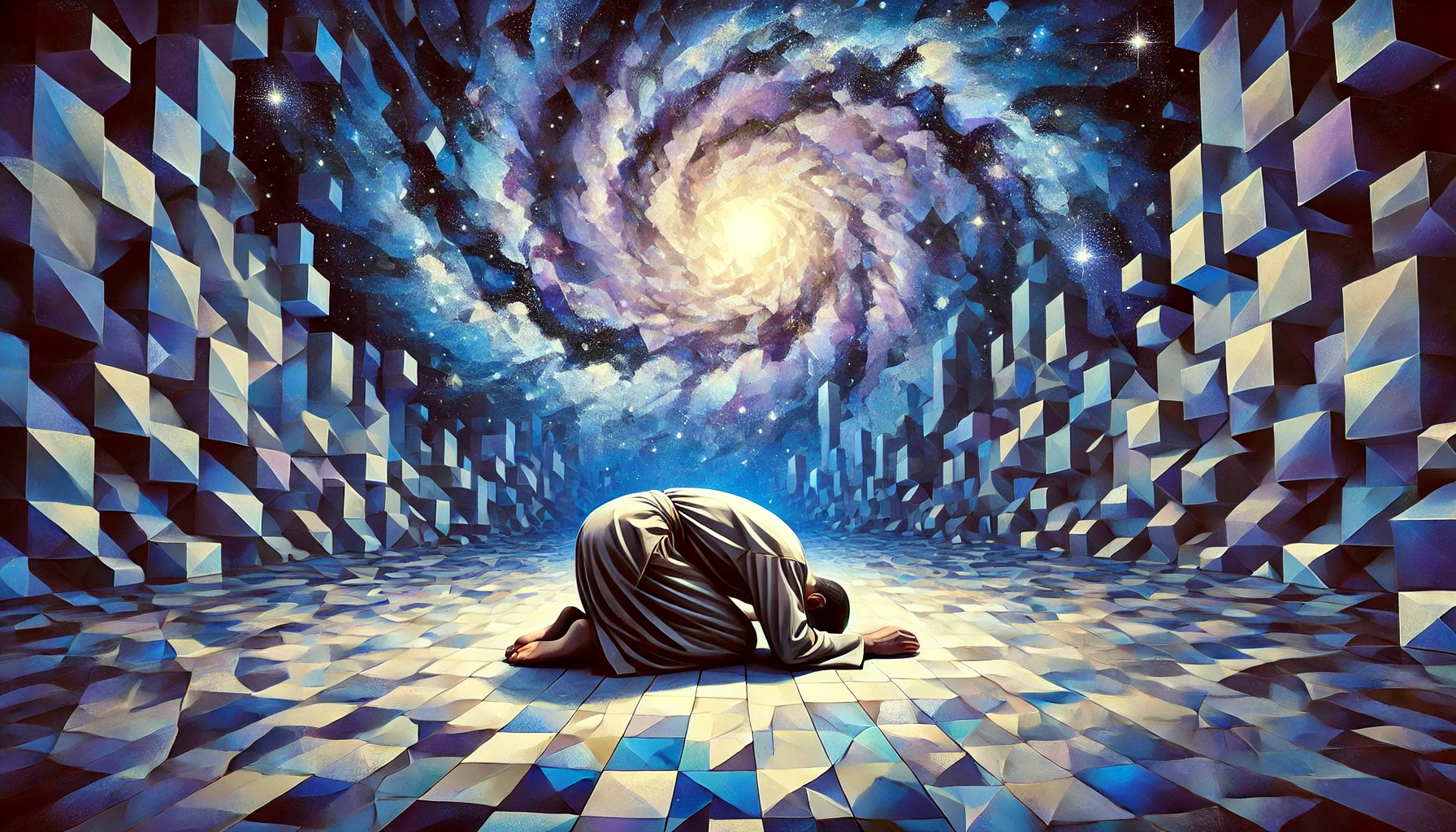
“This comes from Father Anthony Bloom, who was one of the great Russian Orthodox bishops. A young man came to see him in his 20s or so and said, Father, I have no faith. The creeds are dull as dishwater. I can’t believe them. I have difficulty believing that Jesus is the Son of God. I think this stuff is so much nonsense. Can you help me? Anthony looks at him and says, go home and do 100 full prostrations a day for a month and then come back and see me. So in the Orthodox tradition, a full prostration is not just this kind that we do in church in the West and call it a genuflection. It’s a full-on frontal. So the guy came back in a month and he was glowing with faith. Why? There’s an important secret to this. The body knew in putting himself in that position, he suddenly got what oblation means, what full-on commitment means, what being fully enfleshed in both helpless and held means. And the body knows these things.” Cynthia Bourgeault, Awakened Mind Awakened Heart, 03:33 Disc 2 Track 1.
“Rafe had a quote that he loved from Nichol that talked about faith, but this was really what Rafe saw as the essence of the matter of second body building. Nichol said, faith is a continual inner effort, a continual altering of the mind, of the habitual ways of thought, of the habitual ways of taking everything, the habitual reactions. So in other words, for him, it was a struggle against the habitual.” Cynthia Bourgeault, Building 2nd Body June 2022, 20:05 1-what-is-second-body. [I suspect that Rafe was referring to the third-from-top quote above]
“We can’t possibly imagine an energy having intelligence—it goes off the screen of our mind. We can’t imagine an energy having compassion, and we can’t imagine an energy being able to directly create these things. Teilhard was talking about that. If you read his little riff on faith in the divine milieu, he says that faith can directly impact the world, and when it hits a situation when people can bring in a dimension of life of faith into a situation everything in the situation becomes more supple, more relational, more coherent. He understood really clearly that these energy streams that flow out of what we might call the fruits of the spirit are themselves intelligent and efficacious and actually produce on a vibrational level the intentions attributed to them. So we get ourselves out of the driver’s seat where we have to wield this, we have to get together and pray and generate some love you know. Love can speak itself, and what we really need to learn to do is to get ourselves out of the way, again where the Gurdjieff work can help because it teaches us that rather than leaning into things when ecstasy starts to take over, that you stand more firmly in your own ground and let it take over that sets it free to be its own soaring intelligence with the tether in your being, not the flapping wings. So there’s a whole wonderful dialectic here, but if we could really understand that the higher up the ladder of evolution we got as Teilhard insists, the energies themselves become more and more personalized and all the dimensions that Teilhard talks about—spontaneity, freedom, intelligence, coherence, and agency—and we learn to look upon them not as them but thou.” Cynthia Bourgeault, Claymont 2020 October Gurdjieff-Teilhard II, 59:30 017-Gurdjieff and the personal.
Logion 42
Yeshua said:
Be passersby.

Logion 40
Yeshua said:
A grapevine planted away from the Father
has no vitality.
It will be torn up by its roots
and will perish.
Page numbers for Maurice Nicoll refer to Psychological Commentaries on the Teachings of Gurdjieff and Ouspensky (Eureka Editions:2020) unless stated otherwise.
Jean-Yves Leloup, The Gospel of Thomas, Inner Traditions, 2005
Page numbers for Maurice Nicoll’s The New Man refer to Martino Fine Books, Eastford CT, 2019
Read the Impression introducing the Gospel of Thomas.


0 Comments