
From The Gospel of Mary Magdalene, Dialogue 1.
The parts in bold address the nature of sin.
”Tell us about matter. Will it survive or not?”
The Savior answered:
“All of nature with its forms and creatures exist together and are interwoven with each other. They will be resolved back, however, to their own proper origin, for the compositions of matter return to the original roots of their nature. Those who have ears, let them hear this.”
Then Peter said to him:
“Since you have explained everything to us, tell us one more thing. What is the sin of this world?”
The Savior replied:
“Sin as such does not exist. You only bring it into manifestation when you act in ways that are adulterous in nature. It is for this very reason that the Good has come among you pursuing its own essence within nature in order to reunite everything to its origin.”
Then he continued:
“This is also the reason for sickness and death, because you embrace what deceives you. Consider these matters, then, with your spiritual intellect.”
“Attachment to matter gives birth to passion without an Image of itself because it is drawn from that which is contrary to its higher nature. The result is that confusion and disturbance resonates throughout one’s whole being. It is for this reason that I told you to find contentment at the level of the heart, and if you are discouraged, take heart in the presence of the Image of your true nature. Those with ears, let them hear this.”
Having said these things, the Blessed One addressed them:
“Peace be with you. May my peace reside within you. Guard carefully that no one misleads you saying, ‘Look, he is here,’ or ‘He’s over there,’ for the Son of Humanity already exists within you. Follow him, for those who seek him there will find him. Go forth, now, and proclaim the Good News concerning the Kingdom. Beyond what I have already given you, do not lay down any further rules nor issue laws as the Lawgiver, lest you too be dominated by them.”
Having said this, he departed.
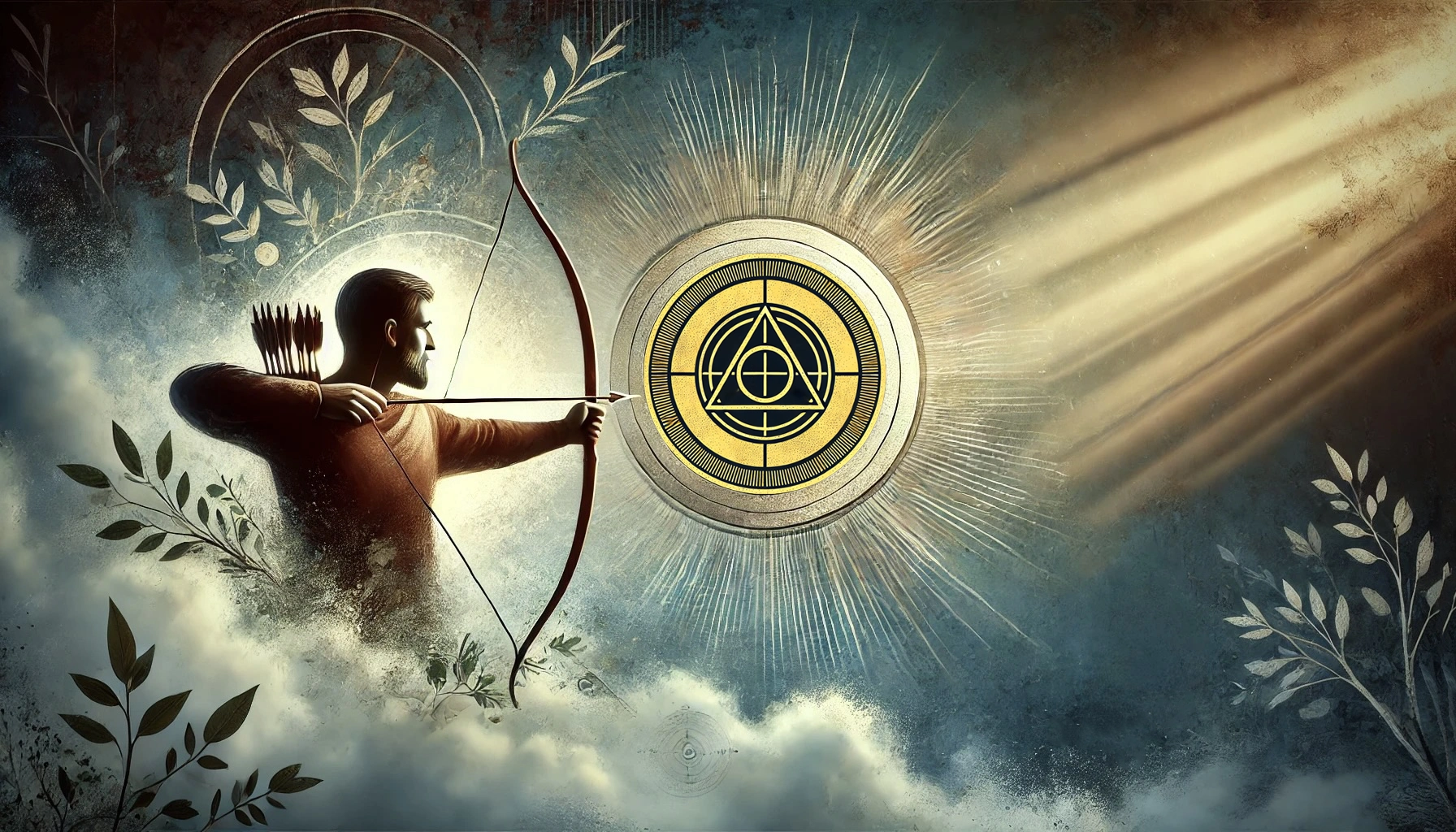
Maurice Nicoll defines “sin” in a specific context: “Sin means to miss the mark. The Greek word άµαρτανω (hamartano) really means ‘to miss the mark’. But it is translated as sin. Literally the word was used in archery when the target was missed. It would seem clear therefore that we cannot understand the idea of sin in the right way unless we gain some idea of what it is we have to aim at. To miss the mark is ‘sin’; but what is the mark?” The Mark, p201-202
Maurice says, “This work if you will listen to it and hear it in your hearts, is the most beautiful thing you could possibly hear. It speaks not of sin but of being asleep just as the Gospels do not really speak of sin but only of missing the mark—the Greek word means that.” p10
Maurice talks about what this target or mark is. As is often his way, Maurice divides it into two levels—the target on this earthly plane and the target at a higher level, the level that Jesus was teaching:
“In the Old Testament, the Ten Commandments were the Mark – that is the Law. Christ said he brought a new law: love one another. He speaks of a certain kind of love – conscious love – and not of emotional love which changes so easily into its opposite.” The Mark, p190
“Paul exclaims that had there been no commandments he would never have sinned. The commandments caused him to sin – a startling idea – just as in the mythos of Adam and Eve the prohibition to eat allegorically the fruit of the tree of knowledge caused sin and the fall of Man. The mark was somehow missed.”The Mark, p202
Jesus himself warns against straying from the target of his teachings in the final words of Dialogue 1, when he says, “Guard carefully that no one misleads you … beyond what I have already given you, do not lay down any further rules nor issue laws as the Lawgiver, lest you too be dominated by them.”
Regarding the words spoken by Jesus: “You only bring [sin] into manifestation when you act in ways that are adulterous in nature.” What is meant here by “adulterous?”
“The commandment: ‘Thou shalt not commit adultery’ is literal but the psychological meaning which is more than this refers to mixing different doctrines, different teachings. That is why it is often said that people went whoring after other gods and so on.” The New Man, p3
The Gospel of Thomas also discusses sin, also different from traditional Christian teachings.
Logion 70 sounds like Yeshua talking about missing the mark:
Logion 70
Yeshua says...
When you give birth
to that which is within yourself,
what you bring forth will save you.
If you possess nothing within,
that absence will destroy you.
Logion 6 sounds like Yeshua warning against following laws instead of his teachings:
Logion 6
His students asked him,
"Do you want us to fast?"
"How shall we pray?"
"Should we give offerings?"
"From what foods must we abstain? "
Yeshua answered,
"Stop lying.
Do not do what you hate,
because everything here lies open before heaven.
Nothing hidden will remain secret,
for the veil will be stripped away
from what lies concealed behind it."
My sense of these teachings is that Paul is observing how the Laws—the Commandments—made him aware of his sin. Yeshua is saying that there is a higher level of meaning, beyond Laws, in which sin is the result of falling out of alignment with the Source of our true nature, with Origin, with God. The aim is not to obey laws, but to seek this alignment. This, to me, is the meaning of Yeshua’s final instructions: “Beyond what I have already given you, do not lay down any further rules nor issue laws as the Lawgiver, lest you too be dominated by them.”
I think Maurice echoes this when he says, “In speaking of the internal mind and how to open it so as to enter the Kingdom of Heaven, Christ repeatedly explained that a man, externally good and pious, but internally quite otherwise, cannot possibly experience this stage of development. He misses the mark. It is the state of his internal and invisible life that matters. What does he really think and feel? Now a man in the Work has to come to the realization for himself how and when he is missing the mark. For example, to let in without resistance and add fuel to and enjoy one’s negative emotions is to miss the mark that the Work has in view. It is to sin against the Work because the Work teaches that negative emotions prevent awakening. Otherwise, it would not be a sin.” p1705
For a discussion on Attachment to Matter from the Gospel of Mary Magdalene, see this Impression.
Page numbers for Maurice Nicoll refer to Psychological Commentaries on the Teachings of Gurdjieff and Ouspensky (Eureka Editions:2020) unless stated otherwise.
Page numbers for Maurice Nicoll’s The Mark refer to Thomas Nelson & Sons, New York, 1954
All quotations from the Gospel of Mary Magdalene and the Gospel of Thomas are from Lynn C Bauman, Ward J Bauman, Cynthia Bourgeault, The Luminous Gospels (Praxis 2008)
Read the Impression introducing the Gospel of Thomas.




0 Comments