
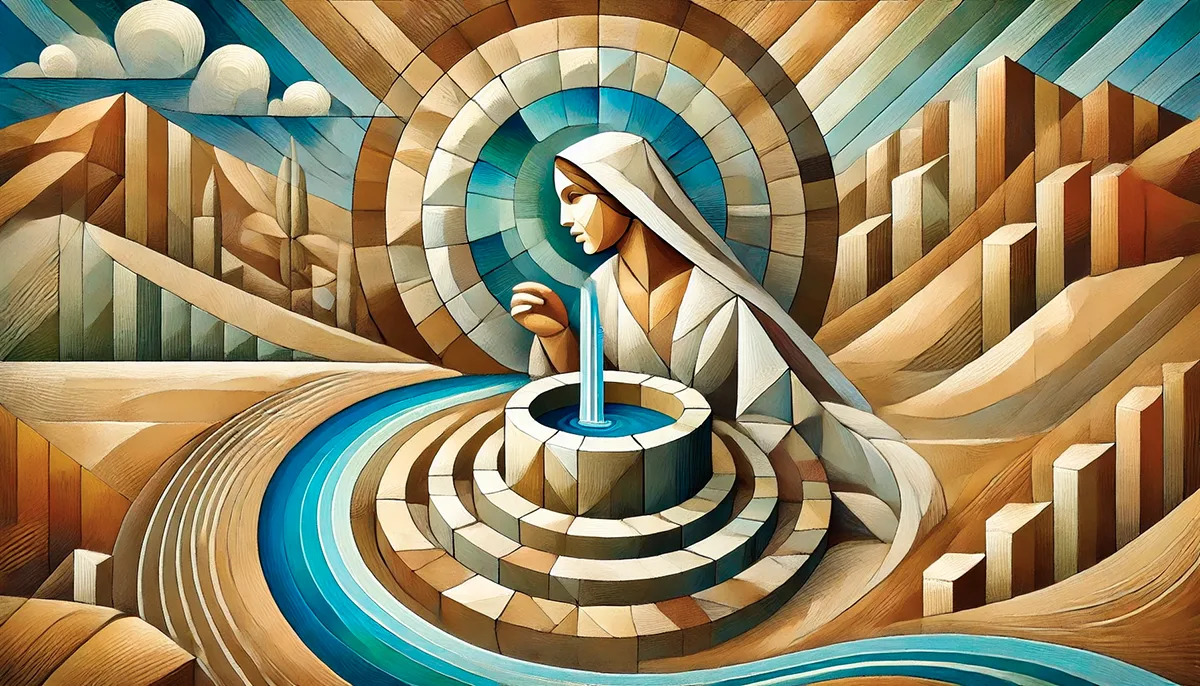
One of the Parables of Jesus, known as the Woman at the Well or the Woman of Samaria, with commentary from Maurice Nicoll and Cynthia Bourgeault.
The Parable:
Jesus, tired out with his journey, sat down by the well to rest. It was about noon.
Presently there came a woman of Samaria to draw water. Jesus asked her to give him some water; for his disciples were gone to the town to buy provisions.‘How is it’, replied the woman, ‘that a Jew like you asks me who am a Samaritan woman, for water?’
(For Jews have no dealings with Samaritans.)‘If you had known God’s free gift,’ replied Jesus, ‘and who it is that said to you, “Give me some water,” you would have asked him and he would have given you living water.’
‘Sir,’ she said, ‘you have nothing to draw with, and the well is deep; so where can you get the living water from? Are you greater than our forefather Jacob, who gave us the well, and himself drank from it, as did also his sons and his cattle?’
‘Every one,’ replied Jesus, ‘who drinks this water will be thirsty again; but whoever drinks the water that I shall give him will never, never thirst. The water that I shall give him will become a fountain within him of water springing up for eternal life.’
‘Sir,’ said the woman, ‘give me that water, that I may never be thirsty, nor continually be coming all the way here to draw water.’
‘Go and call your husband,’ said Jesus; ‘and come back.’
Ί have no husband,’ she replied.
‘You rightly say that you have no husband,’ said Jesus; ‘for you have had five husbands, and the man you have at present is not your husband. You have spoken the truth in saying that.’
‘Sir,’ replied the woman, Ί see that you are a prophet.’
(John iv.6-19)
“A parable, in the Gospels, always begins from the purely sensual level and the ideas belonging to it, and so, taken as such, it seems merely to be what it appears to be – that is, a story about a king, or a vineyard, or a person called Nicodemus, or a Samaritan woman who comes to a literal well in order to draw literal water. In other words, a parable always starts from the first level of meaning that a man acquires from his contact with life – the level of sensual meaning and the ideas belonging to it, which enable a man to live in the world and deal with it according to his natural intelligence. The teaching of Christ is on a different level of meaning, one that refers to the acquiring of quite new ideas, and aims, and new interpretations of life, in the light of a possible individual evolution of man, contained within him as a possibility, but not fulfilled by the action of life or by any mere adaptation to the external world of life and its changing events, passing in time from moment to moment.”
“The woman of Samaria as the ‘soul’ in a man is represented as having had five husbands – that is, it has been wedded to all the five senses in its search for what it believes is best and most true.” Maurice Nicoll, The Mark, p128
“The whole parable is about truth. If the use of the word water is studied in this parable it can be seen that it really has four meanings, one lying behind and beyond the other, as does all meaning in parables. First, on the most external sensual level, it is simply literal water and this level forms the framework. Second, it is water as denoting truth of a certain kind, as the truth connected with the five senses – and this truth is, on its own level, real, because the term marriage is applied to it. Third, it is opinion, theory, mere imagination, which is not called a marriage, but a false relation and so can lead nowhere. And finally it means that order of truth, and those ideas and practices that stir a person inwardly into a state of being alive and form a living spring in him of fresh meanings, so that he never thirsts.” Maurice Nicoll, The Mark, p129-130.
“Taken simply in the linear sequence, this sudden intense exchange between Jesus and an unidentified Samaritan woman seems anomalous. How does she know what she knows? Why can she state so clearly the meaning of Jesus’ earthly mission when nobody else still even vaguely suspects? And why does Jesus receive her with such deep vulnerability? In the light of the counterbalancing elements in the picture, the marriage at Cana, Mary Magdalene in the garden, the anointing at Bethany, the wider interpretive lens begins to open. These are all fractals of the same timeless whole, their celebration of profound redemptive feminine love.” Cynthia Bourgeault, Imaginal WS 8-2020, 01:06:12 0818 IWS Tuesday PM Teaching.
Cynthia talks about the chiastic nature of these interrelated Parables as written about by Bruno Barnhart in The Good Wine: “Particularly lovely to me is [Bruno’s] Day 6, which manages to clump together the four feminine pericopes—the Wedding at Cana, the Woman at the Well, the Anointing at Bethany, and Mary Magdalene in the Garden— in a single symphonic infusion of the feminine energy, celebrating, in Bruno’s words, that ‘the feminine principle in the world is the inexhaustible source of creative realizations of the Father’s glory.’ Through this rapturous chiastic inter-enfolding, passages widely separated from each other in the linear narrative come into spontaneous, synchronous dialogue, reverberating like bells in a bell rack.” Cynthia Bourgeault, Eye of the Heart, p73.
“Any number of writers have commented on [the Parable’s] distinctly nuptial ambiance. The unknown Samaritan woman clearly bears the energy signature we have identified as Magdalenic: spunky, outspoken, and honest, and with an independence bespeaking of a somewhat maverick personal history.” Cynthia Bourgeault, The Meaning of Mary Magdalene, p238-239.
Logion 108
Yeshua says...
Whoever drinks what flows from my mouth
will come to be as I am
and I also will come to be as they are,
so that what is hidden will become manifest.

from Logion 13
Yeshua said,
"Thomas, it is no longer necessary for me to be your Master
for you are drinking from the gushing spring
I have opened for you,
and you have become intoxicated."
Read more Impressions of the Parables of Jesus.
Quotations from the Gospel of Thomas are from Lynn C Bauman, Ward J Bauman, Cynthia Bourgeault, The Luminous Gospels (Praxis 2008)
Page numbers for Maurice Nicoll’s The Mark refer to Thomas Nelson & Sons, New York, 1954
Cynthia Bourgeault, Eye of the Heart, Shambhala Publications, 2020
Read the Impression introducing the Gospel of Thomas.




0 Comments