
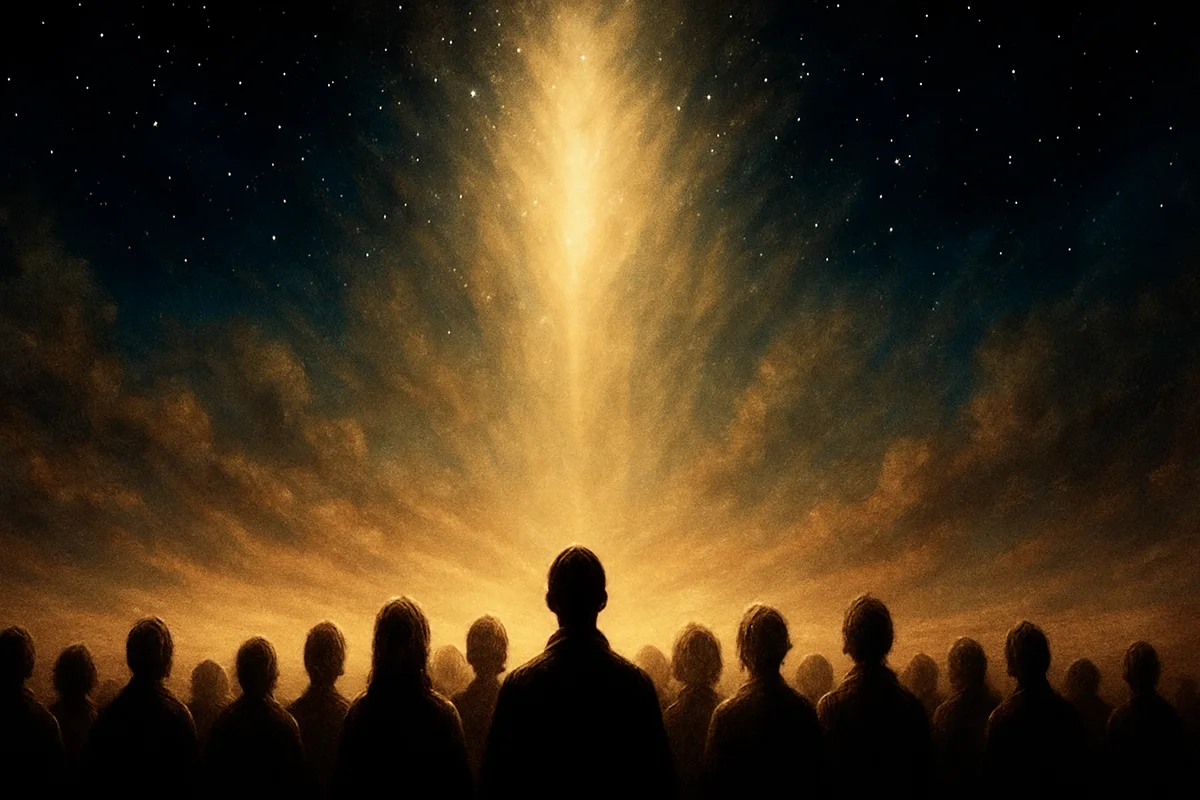
“In the Lords Prayer there are innumerable ideas. Each phrase has inner octaves.” Maurice Nicoll
Sacred Gestures of Exchange
“Many people have observed that when you say the Lord’s Prayer you look at how exchange is so much a part of it. This becomes particularly clear if you look at it not as a bunch of words but as sacred gestures. You know, there’s the vertical sayings our father in heaven give us this day our daily bread. So there’s that vertical exchange. Then there’s the horizontal. You know, forgive us as we forgive those. Vertical, horizontal. Its biaxial exchange is implicit in that prayer. Some people say that it’s not a prayer at all in terms of being a spoken prayer. But it’s a body prayer where you explore these dimensions of vertical exchange and horizontal exchange.” Cynthia Bourgeault, Claymont 2012 Gurdjieff for Christians, 13:00 20 Saturday Afternoon Teaching.
The Prayer as Complete Teaching
“In the Lord’s Prayer there are innumerable ideas. Each phrase has inner octaves. There are so many things in it to a man who has formed the ideas of the Work in his mind that to speak at all fully about the Lords Prayer is to speak about every side and every single thing in the Work itself. To read the Prayer at times and think of all its connections, beginning with the octave from the Divine Intelligence of the Sun in which Man is created and of all the Work says of Man and his inner state and what he must do to awaken, is to use the Prayer in its real sense. To repeat the words is useless.” Maurice Nicoll, Psychological Commentaries, p158.
“To pray only for oneself, to work only with regard to oneself and those connected by self-interests with one cannot give any result. Three forces must enter prayer, and this is too difficult to speak of at present, but you will find them in the Lord’s Prayer if you think long enough about it.” Maurice Nicoll, Psychological Commentaries, p159.
Daily Bread: The Food of Being
“When it is said in the Lord’s Prayer: ‘Give us this day our daily bread,’ it is not literal bread that is meant. This is no ordinary bread that is asked for, but the very food through which a man can grow internally, in his own being, in his own thought, in his own feeling, in his own understanding. But if this transformation or re-birth of a man – with which the Gospels are solely concerned and of which they speak in almost every line – if this transformation is possible, there must be something internally close to or touching every man which, if he can hear, if he can feel and begin to understand and eventually follow, will lead him to metanoia, to this re-turning, and thus to an entirely new sense of himself and the meaning of his life on earth. This part of the Lord’s Prayer is a personal request to feel what has been lost, this lost feeling, and to feel it now – this day, this moment – because this feeling is food – not literal food – but the food that enables a man to become alive.” Maurice Nicoll, The Mark, [somewhere in “Part Four”]
Forgiveness: Canceling Debts
“Unless you cancel your debts, nothing in you can grow. It is said in the Lord’s Prayer: ‘Forgive us our debts as we forgive our debtors.’ Feeling you are owed, feeling debts, stops everything. You hold back yourself and you hold back the other person.” Maurice Nicoll, Psychological Commentaries, p253.
“A phrase in the Lord’s Prayer says: ‘Cancel what we owe to God, as we cancel what we think others owe us’. That is, as long as your life is based on imagining that others owe to you, you will get nowhere. But as more and more you see that no one owes you anything and that it is always your own fault—then your accounts, spiritually, are cancelled.” Maurice Nicoll, Psychological Commentaries, p912.
The Heaven-Earth Balance
“The Lord’s prayer reveals to us the principle of the justice of grace and the operation of weighing by means of the ‘heaven-earths’ balance. There it is said: ‘Forgive us our trespasses, as we forgive those who trespass against us.’ And then the Master adds: ‘For if you forgive men their trespasses, your heavenly Father also will forgive you; but if you do not forgive men their trespasses, neither will your Father forgive your trespasses’ (Matthew vi, 12, 14-15).
“The Master is explicit with respect to the balance operating between earth and heaven …‘if you do not forgive men their trespasses, neither will your Father forgive your trespasses’—this is the law, this is the infallible and implacable operation of the ‘heaven-earth’ balance. That this balance governs not only forgiveness but also the entire domain of gifts from above, understood as the Holy Spirit.” Valentin Tomberg, Meditations on the Tarot, p179.
Prayer in the Name of Humanity
“The Lord’s prayer is not addressed to ‘my Father in heaven’, but rather to ‘our Father in heaven’, and asks the Father to ‘give us this day our daily bread’, that he ‘forgive us our trespasses’, that he ‘leads us not into temptation’ and that he ‘delivers us from evil’. Thus, whatever the particular intention of the one who prays the Lord’s prayer may be, it is in the name of the whole of mankind that he prays.” Valentin Tomberg, Meditations on the Tarot, p639
Logion 95
Yeshua says…
If you have money, do not lend it at interest.
Give it instead
to someone from whom you cannot take it back.
Page numbers for Maurice Nicoll refer to Psychological Commentaries on the Teachings of Gurdjieff and Ouspensky (Eureka Editions:2020) unless stated otherwise.
Quotations from the Gospel of Thomas are from Lynn C Bauman, Ward J Bauman, Cynthia Bourgeault, The Luminous Gospels (Praxis 2008)
Valentin Tomberg, Meditations on the Tarot, Jeremy Tarcher, 1985
Read the Impression introducing the Gospel of Thomas.
Read the Impression on Meditations on the Tarot.




0 Comments