
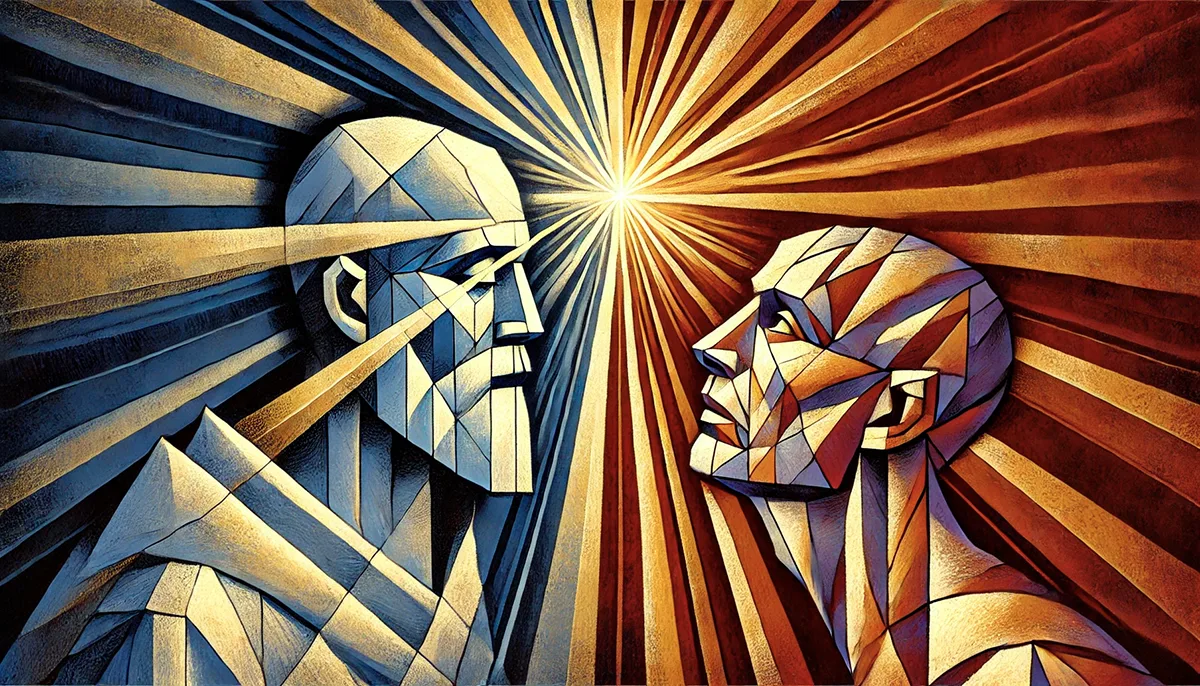
“The Gospel of John is written from the marriage of Good with Truth. For this reason at the very beginning of John’s Gospel, the grace and truth of Jesus Christ are contrasted with the Truth (the ‘law of Moses’).” Maurice Nicoll
The Nature of Grace and Truth
“You must begin to have not only right thinking, right knowledge, but right Being. What is right Being? Being is different from truth. Being is just like this: Good = good will. Will belongs to Being. What is charity? Charity in the Greek = grace—graciousness. In the Gospel of John it is said of Christ: ‘And we beheld him full of grace and truth.’ Notice grace comes first. Just take your fanatical truth-people and reflect.” Maurice Nicoll, Psychological Commentaries, p1126-27.
“Christ refers to the side of the Truth of the Word of God—that is, the Truth that can guide a man to inner self−evolution. And the word Jesus always refers to the Good of the truth. The Good and the Truth are united in Jesus Christ. In the words of John: ‘Grace and truth came by Jesus Christ.’ (John i, 17.) The Gospel of John is written from Good or the marriage of Good with Truth. For this reason at the very beginning of John’s Gospel the ‘grace and truth of Jesus Christ’ are contrasted with the Truth (the ‘law of Moses’) represented by John the Baptist.” Maurice Nicoll, The New Man, p72.
“St. John says that Christ was in the fulness—that is, in the fulfilment of Truth which is Good—and so full of grace and Truth. And these early words in St. John give the key to this Gospel, which is written in a different way from the first three Gospels and creates a different feeling. For it is written from grace, from Good, the emotional feeling of what Christ stood for in the world, and not from the side of Truth devoid of grace, from the letter, from the literal fact. In consequence, the whole Gospel produces a different impression of Christ’s teaching and falls upon a different part of the understanding.” Maurice Nicoll, The New Man, p200-201.
Grace vs. Literal Truth
“To take the word of the law literally is to do violence to others and to oneself. The literal sense, say, of a parable, does not convey its inner levels of meaning. Literal truth is without mercy, grace or charity, and can be most crude and most violent in its results, as we see in religious persecutions.” Maurice Nicoll, The Mark, p172.
“Having no grace or inner charity or human kindness, and so no wedding garment, is nothing but a man of self-will and violence and not a man at all, in the sense of Christ.” Maurice Nicoll, The Mark, p173.
“The higher must be established beyond all doubt, for only this reverses us and makes Personality passive so that Essence grows. For this turns us the right way up. The self-love turns everything the wrong way round so one can never grasp what the Work is or why. The literal, which is narrow, exacting, brittle, and without grace, then crucifies daily the psychological. Sense crucifies daily the spirit. The self-love remains intact.” Maurice Nicoll, Psychological Commentaries, p1556.
The Justice of Grace
“The sun shines on the good and wicked alike. Is this morally right? Is it the justice of grace here which is higher than the protective, distributive and punitive justice of the law? This is so. There is the sublime ‘other justice’ of grace, which is the meaning of the New Testament.” Valentin Tomberg, Meditations on the Tarot, p178.
“The Work is a unity. Actually it is a living whole, but it only becomes a living whole when it is taken in by the mind with some degree of grace and gradually connected up rightly by thought and memory and by hearing it taught time after time. Then it becomes a living whole, a light in you.” Maurice Nicoll, Psychological Commentaries, p1568.
The Omnipresence of Grace
“My own experience is that the layer that surrounds the world and holds it and is the impartial field in which we live and move and have our being is, by nature, compassionate and intimate. That is its objective nature, and when we can get out of the way our own terror and insistence and frenzy, that we join a field which is by its own essential nature help. So it’s always there. People like to imagine that you do the right kind of abracadabra, and in comes grace. Grace is always there. It’s us who disappear.” Cynthia Bourgeault, Claymont 2014 Jacob Boehme, 29:50 5e.Satpm.TeachingGWS14.
“In a sense, all is given in grace already, and it’s just because we keep trying to shoehorn things into a linear timeline that we sometimes can’t see the thickness, the fullness of the whole picture, where grace is at work even in what we think is chaos, which is symmetrically balancing something that’s rising.” Cynthia Bourgeault, Imaginal Wisdom School 2020, 16:35 0818 IWS Tuesday PM Teaching.
Grace in Spiritual Practice
“The Christian doctrine and experience of grace expresses the very essence of chastity, just as it also contains the principles of poverty and obedience. The principle of grace underlies earthly life as well as spiritual life. It is wholly—below and above—ruled by the laws of obedience, poverty and chastity. The lungs know that it is necessary to breathe—and they obey. The lungs know that they are in want, and they breathe in. They love purity—and they breathe out. The very process of breathing teaches the laws of obedience, poverty and chastity, i.e., it is a lesson (by analogy) in grace. Conscious breathing in of the reality of grace is Christian Hatha-yoga. Christian Hatha-yoga is the vertical breathing of prayer and benediction—or, in other words, one opens oneself to grace and one receives it.” Valentin Tomberg, Meditations on the Tarot, p134.
The Marriage of Human Effort and Divine Grace
“Tears, sweat and blood are the three substances of the threefold mystical-gnostic-magical Mystery of man. To be touched from above is ‘tears’; the effort to conform to that which is above is ‘sweat’; and the consummated marriage of grace from above and effort from below is ‘blood’. Tears announce the engagement of the eternal and the temporal; sweat is the trial that this entails; and blood is the region where the wedding of eternity and the moment is celebrated and where their marriage is consummated. But the Mystery, I repeat, is whole and indivisible: tears, sweat and blood—engagement, trial and wedding—faith, hope and love.” Valentin Tomberg, Meditations on the Tarot, p387.
“The process of induction (which ‘ascends from earth to heaven’) and that of deduction (which ‘descends to earth’), the process of prayer (which ‘ascends from earth to heaven’) and that of revelation (which ‘descends to earth’)—i.e. human endeavor and the action of grace from above—unite and become a complete circle which contracts and concentrates to become a point where the ascent and descent are simultaneous and coincide. And this point is the ‘philosopher’s stone’—the principle of the identity of the human and divine, of humanism and prophetism, of intelligence and revelation, of intellectuality and spirituality.” Valentin Tomberg, Meditations on the Tarot, p607.
Logion 94:

Yeshua said,

Whoever seeks will find;

whoever knocks from inside, it will open to them.
Page numbers for Maurice Nicoll refer to Psychological Commentaries on the Teachings of Gurdjieff and Ouspensky (Eureka Editions:2020) unless stated otherwise.
Page numbers for Maurice Nicoll’s The New Man refer to Martino Fine Books, Eastford CT, 2019
Page numbers for Maurice Nicoll’s The Mark refer to Thomas Nelson & Sons, New York, 1954
Valentin Tomberg, Meditations on the Tarot, Jeremy Tarcher, 1985
Jean-Yves Leloup, The Gospel of Thomas, Inner Traditions, 2005
Read the Impression introducing the Gospel of Thomas.


0 Comments