
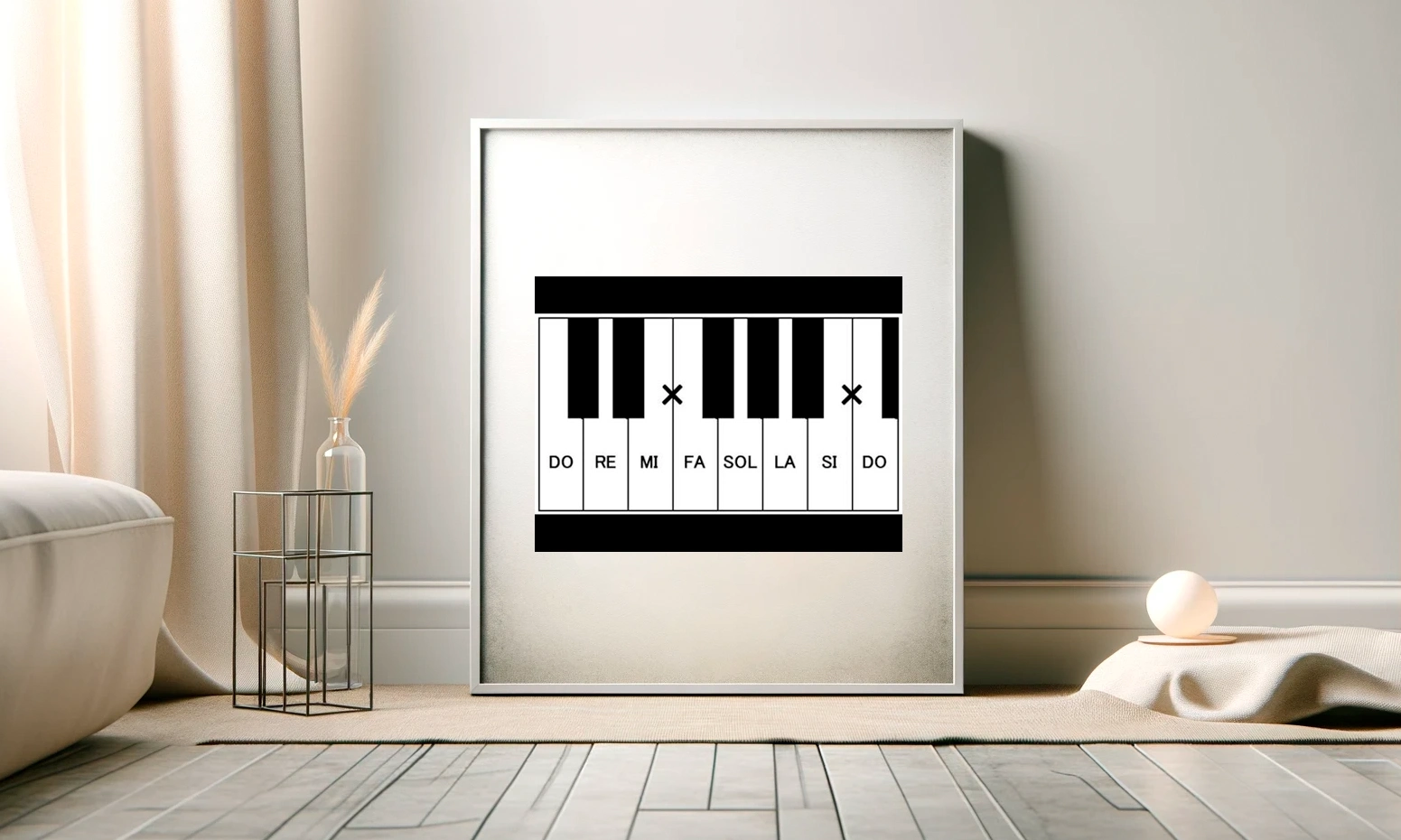
The idea of octaves weaves through the Gurdjieff teachings. This relates to one of the primary ideas of the work: the Law of Seven, or Law of Octaves, or the Law of Order of Manifestation.
The Law of Seven describes the process of development through seven stages, represented as an octave. The law highlights the discontinuities and intervals (or shocks) necessary for progress. In human development, these shocks often come in the form of crises or significant insights that propel an individual to higher states of Being. The Work Octave might be thought of as the octave of a person’s development.
The supreme example of the Law of Seven is Gurdjieff’s cosmology—the Ray of Creation. But in this post, the octave, or the order of things, is applied to an individual’s progress in raising their level of Being. This is an example of how the overarching laws of manifestation cascade down through the realms until they land, very personally, in you. As Cynthia Bourgeault often says, the drop is in the ocean, and the ocean is in the drop.
A key starting point is to understand that the Work Octave is ascending. This means that the notes begin with Do-Re-Mi, and it also signifies that personal development is ascending towards a higher level of Being, reaching towards help coming down from a higher realm.
Early in the Commentaries Maurice Nicoll talks briefly of the Work Octave. M outlines the nature of Do-Re-Mi in the Work. The note of Do and the beginning of the Octave are sounded by valuation of the Work, the teachings. “This valuation is due to the action of a kind of Magnetic Center in you.” Commentaries, p207
I remember back to that first day at the Stonington Ingathering when Cynthia spoke to me in a way that was so different and yet so deeply familiar. Cynthia’s words landed on me as pure, golden, valued resonance. I went back to the cottage that we were staying in, feeling dumbfounded. How did she do that? It was like a magic trick. Now, six years later, after gathering much understanding of these teachings, I would say that Cynthia was speaking to Essence rather than Personality. Almost everything in our world speaks to Personality. Very little speaks to Essence.
“Everyone enters the Work with Personality at full blast. Later, there are more inner thoughts on the whole matter. “Here is where a person is close to sounding Do or not. To sound Do (and start the Work Octave) is to value the Work with inner sincerity. The Work begins in you when you have to struggle with it yourself and keep it alive by and for yourself. It means a continual struggle in yourself to get to what is real and to discard the pretended and invented side. Here, one enters a sort of desert in which one is tempted a great deal in regard to the Work itself.” Commentaries, p505
Logion 69
Yeshua says...
Blessed are all those who are persecuted
down into the depths of the heart.
Only there will they come to know
their true Father and Source.
Blessed are the hungry ones.
Their inner longings will be satisfied.
On p1074, Maurice begins a series of talks on the Work Octave. This is becoming familiar ground. The Work Octave is an ascending octave, and the note Do must be sounded strongly in order to move forward. This is equivalent to valuing the Work, the Wisdom Teachings, strongly. The next note in an ascending octave is Re, which is defined as “The application of the Work ideas to oneself.” The following note Mi is called “The realization of personal difficulties.” Between Re and Mi “lie all the processes of connecting the Work with what one observes.” Commentaries, p1075
M further illuminates the idea of the note Re by connecting the teachings with what one observes and how this puts things in the right order. In our usual mechanical state, unimportant things are made important, and important things are made unimportant. A strong note of Do (seeing the value of the teachings), in turn, sounds a strong Re as we begin to observe the reality of the teachings.
Now we have notes Do, Re, and Mi sounding and strengthening each other as we see the Teachings’ value more and more. “When this is the case, the gap between Mi-Fa may begin to be bridged and the note Fa begin to sound. This note Fa is always a new thing in one—as if another being with a new understanding had begun to grow in one’s being.” Commentaries, p1075
Note Fa comes as we begin to realize the facts about ourselves through self-observation. M says to “remember that self-observation is to let a ray of light into the inner darkness of yourself.” p1106 The task at this note is to be passive to our faults and difficulties, acknowledge them and separate from them. Through this conscious work, the note Fa may begin to sound. The note Fa is “an utterly different feeling, something delicate and new.” M describes this as an “undefinable effort” that one can only make from the deepest sense of oneself. This has to do with Essence rather than the usual effort of Personality.
M says that in every aspect of life, it is difficult and rare to reach the note Fa. A person, a business, or a group is stuck in Do-Re-Mi. “In whatever branch of life you are, to strike Fa means at once that you are at a far higher level than others. The reason is that the person has made some curiously undefinable individual effort that lifts them beyond this gap.” p1076 M says that “imitation will never do it.” This is curious to me because other times M has suggested imitating a higher level in order to attract that level. Finally, in this part of the discussion on the Mi-Fa gap, M speculates once more on recurrence—that some individuals, especially musicians, pass the Mi-Fa gap so quickly that it cannot be explained in terms of one life.
M continues on p1078 to outline the beginning of the Work Octave, and he makes a startling assertion: the first note of the Octave, Do, is passive. This octave is ascending, and all ascending octaves begin with a passive Do. As noted before, this passive note is the valuation of the teachings, and the valuation must be strong before you can get much further than Do.
Hmm—this is different than my lifetime mantra of “if you can say it out loud, you can make it happen.” That sounds like a very active beginning. Or is it? Saying it out loud may relate more to yearning than acting. “I want to live from Good” is a statement of valuation—and M is saying that the starting place is not active doing, but is passive valuing. M relates this valuation to some of the parables/Logia, such as the merchant who found the one pearl and gave up everything for it or the man who found a treasure hidden in a field and sold everything he had to buy that field.
As you pass into Re and learn the teachings, and then into Mi, where you realize that you cannot simply do as you will, you will have to let go of yourself and begin to learn and live the meaning of the Teachings beyond the words of the teachings. Then the note Fa may sound in you.
I feel lately that I’ve entered a new phase, maybe that Mi note that M talks about, where these teachings are not “a part of my life,” like some course that I’m taking. The aim to Live from Good, the aim to live from the teachings, is the life, not a part of it.
Logion 8
Yeshua says...
A true human being
can be compared to a wise fisherman
who casts his net into the sea
and draws it up from below full of small fish.
Hidden among them
is one large, exceptional fish
which he seizes immediately,
throwing back all the rest without a second thought.
Whoever has ears let them understand this.
“When a man or woman reach sufficiently the stage of understanding of the Work called the note Mi, through strengthening of the notes Do and Re, then they are close to receiving help from the Work. If they will be passive to their faults and difficulties, acknowledge them and separate from them, then the note Fa may begin to sound in them. This note is an utterly different feeling. It is something delicate and new. Yet this is the beginning of meeting Real ‘I’, which is nothing like what they thought was Real ‘I’. It is possible to say that some may not accept this new feeling of what they are.” p1077-78
M continues talking about becoming more conscious at note Mi. “Positive ideas are necessary to lift a person from Mi to Fa. The first requisite for Positive Ideas is the belief in Greater Mind—or the Ray of Creation.” p1077
Note: the following notes from my journal are from a year later when I went through the talks on the Work Octave a second time. It’s interesting to see a deeper acceptance of the Teachings.
Maurice continues with a 2nd talk on the Work Octave. p1078 M states that the Work Octave is an ascending octave and, therefore, starts with a Passive Do. It does not start with work but with valuation. It begins not with doing but with valuing. It is like the merchant who found the pearl of great price or the man who found the treasure in a field and sold everything to buy the field. These are parables of valuation. M further states that it is useless doing this Work, following these Teachings, unless one believes in the existence of Greater Mind—the Conscious Circle of Humanity. So, the Teachings are coming down from a higher level, and therefore a person cannot begin from thinking they can do something. The whole process begins with knowing that one does not know in the presence of the Greater Mind. It’s really quite simple, I think. In reading Maurice, Cynthia, or the Gospel of Thomas, one is receiving teachings from a higher level, so there is nothing to do except make oneself available. Sarah and I both had this sense immediately, being at Wisdom Schools with Cynthia teaching—don’t ask questions, don’t seek explanations, sit with attention and absorb what is coming towards you.
Eventually, through the valuation of the Teachings and the practices of Self-Remembering—the process of becoming “Poor in Spirit,” M says the note Fa becomes possible. “And it is here that you cannot do, and others cannot do. And because you know and understand yourself better and have lost many conceits, you know and understand others and cease to judge them. It is when you have reached this stage that the Work itself may begin to speak to you internally because you have learned something of the language in which it speaks. This is why the note Fa becomes possible.” p1080 I would add that for myself, at this stage of the journey, the various forms of the Teachings all begin to speak the same language, and many connections and cross-reinforcements start happening. Maurice, Cynthia, Yeshua—what was cryptic begins to speak in unison.
In talk III on the Work Octave, M says, “For right valuation, the Work must become emotional.” p1080 If it does not reach the Emotional Center, it remains a detached memory of the Intellectual Center, not affecting one’s life. As has been recorded before, “One of the supreme objects of the Work is to awaken the Emotional Center.” p1080 Our valuation of the Work must become emotional. M talks of the “impure state” of the Emotional Center, from the negative emotions that govern us all. It is a “marvelous source of negative emotions and general unhappiness.” So we work—“real, practical, hard work—against negative emotions, by non-identifying with them, not consenting to them, not believing them, separating the feeling of ‘I’ from them.” p1081
Only realizing the truth of the Work and awakening the Emotional Center makes it possible to pass from Mi to Fa. M states that if the Emotional Center “begins to work aright, it marvelously supplies us with what we lack and gives an inner source of force that I cannot explain in any words.” p1080 Work on purifying the emotions. Blessed are the pure in spirit.
On p1082, there is a long quote from Ouspensky, talking of “pure or impure emotions,” not in a moralistic sense, but whether the pure emotion is mixed with other emotions that muddy the fundamental feeling. Ouspensky says that it is impossible to know through impure emotions. For example, when pure sympathy is mixed with a calculation of receiving something in return, or when pure love of knowledge is mixed with profiting from the knowledge. This seems to me to be a description of how Good lands in our realm on our terms, that pure Good seems foreign to us. Ouspensky finishes by stressing the “purification and elevation” of emotions in order to correctly understand the world.
Ouspensky says, “All emotions colored by such self-elements are like concave, convex, or otherwise curved glasses which reflect rays incorrectly and distort the image of the world.”
“Become as little children …’ and ‘Blessed are the pure in heart …’ In these evangelical words is expressed first of all the idea of purification of the emotions. It is impossible to know through impure emotions.” (end Ouspensky quote)
Note: All page numbers refer to Maurice Nicoll, Psychological Commentaries on the Teachings of Gurdjieff and Ouspensky (Eureka Editions:2020) unless stated otherwise.
All quotations from the Gospel of Thomas are from Lynn C Bauman, Ward J Bauman, Cynthia Bourgeault, The Luminous Gospels (Praxis 2008)
Read the Impression introducing the Gospel of Thomas.





This is so helpful to me right now! Thank you!
Thank you for the feedback, Chris
I am reading your post on the law of octaves and don’t read well from the screen. Is there any way I can print this to have a paper copy?
Hi Shelly,
Wordpress is blocking the cut/paste from the site, but you can use control + (Windows) or Command + (Mac) on your browser to increase the type size. Hope that helps.
Bill