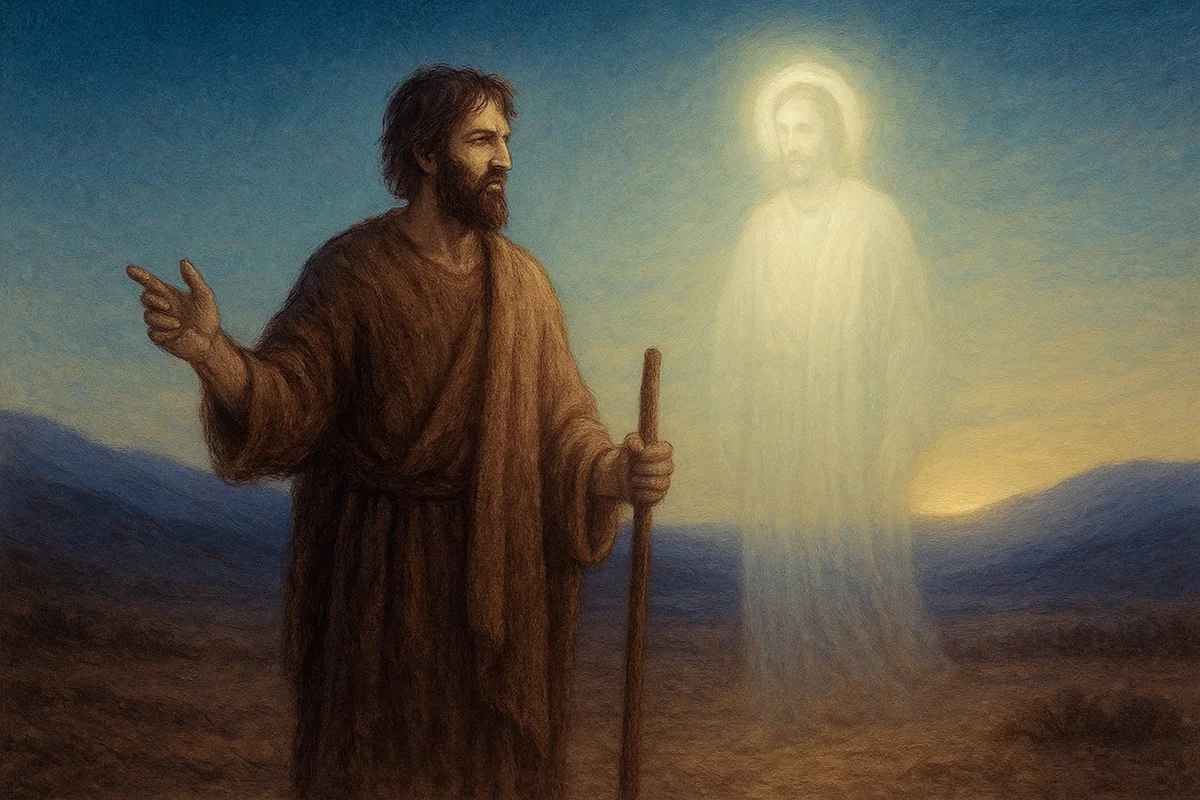
“John the Baptist represents the side of Truth—that is, the law, without its grace. Christ is the union of Truth with Good. Good is above Truth. All Truth must lead to good.” Maurice Nicoll
A Bridge Between Two Worlds
“Jesus Christ could not come into another milieu than that of virginal innocence and innocence recovered through penitence. John the Baptist is therefore the one who—in the history of the world—accomplished the act of transition from penitence to communion; it is he who led by the hand the first penitent from the ancient world to the altar of grace of the new world.” Valentin Tomberg, Meditations on the Tarot, p484.
“It was thus that John the Baptist transmitted the fruit of the world which had come to an end to the world which was beginning. If the three holy kings (magi) laid at the feet of the child Jesus the threefold quintessence of what the ancient world had achieved—gold, frankincense and myrrh—St. John the Baptist gave the Master a fourth gift: the pure heart which could see the Divine (“Behold, the Lamb of God”), of which the Master was to say: ‘Blessed are the pure in heart, for they shall see God’ (Matthew v, 8).” Valentin Tomberg, Meditations on the Tarot, p485.
“Aren’t the three weeks of Advent an abridgment of this preparation through millennia—the fourth week being their summary: the work of John the Baptist?” Valentin Tomberg, Meditations on the Tarot, p487.
The Highest Born of Women
“Of all the strange figures that appear in the Gospels John the Baptist is one of the strangest. Yet perhaps more is said of him in definition than is said of any of the others. For example, Christ defined him as the highest man of those born of women but added that the least in the Kingdom of Heaven was greater than he. What, then, does John the Baptist represent? What does he stand for in the Gospels? And why is his teaching given first, before Christ comes?” Maurice Nicoll, The New Man, p141-142.
The Literal Teaching of Truth
“John the Baptist represents the literal teaching of the Word of God. He represents the great literal class of such people whom, in the person of the Baptist, Christ defends, since they are the starting-point of all else, and speaks about with such great and obvious care as if they presented a problem very difficult to solve. John the Baptist believed in Christ when he met him, but, as was said, towards the end he is shown to have doubted. And this is the true psychological picture of those who, being grounded in the external side of the teaching of the Word and its harsh literal meaning, meet with the internal or higher meaning of it and are unable to comprehend it and fall back in doubt.” Maurice Nicoll, The New Man, p146.
“John the Baptist represents the side of Truth—that is, the law, without its grace. Christ is the union of Truth with Good. Good is above Truth. All Truth must lead to good. But, as we have seen elsewhere, Truth must come first and Good second, until Truth unites with its Good. Then Good comes first and Truth second.” Maurice Nicoll, The New Man, p200.
He Must Increase, I Must Decrease
“John the Baptist said of Christ: ‘He must increase, but I must decrease. He that cometh from above is above all: he that is of the earth is of the earth, and of the earth he speaketh: he that cometh from heaven is above all.’ (John iii, 30, 31.) Later John the Baptist was beheaded at the request of the daughter of Herodias, prompted by her mother, whose marriage with Herod, her husband’s brother, John had condemned from a legal point of view. It is clear that John the Baptist knew what would take place. All this can only be understood in terms of an eventual stage that could be reached by John, by his deliberate undertaking of this difficult part, which, in a physical sense at least, was as painful as that played by Jesus.” Maurice Nicoll, The New Man, p189.
The Limitation: External vs. Internal Truth
“Christ said: ‘The Kingdom of Heaven is within you’ – that is not in the future or in some locality – a thing which perhaps John the Baptist had not grasped. For external, literal truth does not grasp internal, psychological, spiritual truth. Yes, Heaven is not a place above and Hell not below in space. Heaven and Hell are within a man, so we notice that the conception of the Kingdom lay first in the future in time, then as being present in time and space, and finally as being in a man himself apart from external time and space.” Maurice Nicoll, The Mark, p172.
Advent’s Funneling: From Vast to Particular
“It begins in the first weeks in late November, early December with stories of the apocalypse, of the second coming, of the Son of Man, of the shake-up of the planet. You’re going to see the signs and wonders. We start at the end of time, at the most vast and wide, expansive and in some ways fearsome time. And people say, this is one hell of a way to start a season of festivity with warnings about the final coming and the destruction of the planet. But that’s what it does. And each week, it funnels down.
“You begin to see more points. All of a sudden you start out with this kind of Son of Man out there coming to judge the living and the dead. The next thing you know, John the Baptist shows up out of nowhere and starts randomly preaching in the wilderness. And then you go, still funneling, funneling down until you get the stories of the Annunciation at its ends. It dumps you on Christmas Eve at the birth of Jesus on the manger. So it goes from the incomparably vast and scary to the particular, to the exquisitely particular.
“And with each new week, it gets a little bit sweeter until it winds up completely tender. But it’s a very interesting, unusual construction. Using time, as it were, to paint and yield an emotional effect inside you.” Cynthia Bourgeault, Integral Light Dec 2021, 17:43 1.1 Temporicity.
The Mutation of Consciousness
“Why do they take a whole week in Advent and spend the time comparing Jesus and John the Baptist? Which one is the greater? Which one is qualitatively the different? You may say, when do we get to the chase? When do we get Mary? When do we get the birth? When do we get the wife? What’s going on here? But there’s some really subtle points going on this week. And as you look at the text for Advent week three, they tend to start by and large a little bit later in the story, when Jesus is already beginning to minister, when John the Baptist got arrested and imprisoned.
“And John the Baptist’s disciples are coming to ask, are you the one to come, or shall there be more? And biblical scholars have made great sense of things, and you can’t discount it, that in the context of this time, it was a living fight, that Jesus began his life as a student of John the Baptist. John the Baptist was his teacher. He was baptized at the hands of John the Baptist. And then he went on. He wandered out into the wilderness afterwards. And whatever happened to him in the wilderness, he moved beyond his teacher in space time, his midwife in space time, and began to offer a teaching of a whole different quality and order of magnitude.
“What we’re seeing is Jesus as the headwater of a whole new mutation, a whole new jumping forth of oarsprung, of origin into form. And this gospel, this week, is spending some time inviting us to consider the scale of things and consider how things shift when consciousness mutates to a radically different order of luminosity, of radiance, and how people are both undone by that and attracted by it.” Cynthia Bourgeault, Integral Light Dec 2021, 18:41 1.2 Chiastic Advent.
Two Paths: Renunciation and Kenosis
“If you often ask why is it that the Gospels pair Jesus with John the Baptist as his herald, I think it’s because we need to look closely at the two kinds of spiritual path that we’re seeing here. John the Baptist was a classic celibate renunciate and in the path of celibate renunciation, brahmacharya, the teaching does remain true. That you need to hold on, you need to push away, hold yourself back from the things that dissipate the energy, because the path that you’re practicing relies on the concentration, refinement, and raising of the energy.
“There’s evidence that Jesus passed through the Essene school, but there’s pretty strong evidence that he didn’t remain there, and that what he came out teaching was not an Essene doctrine. What he somehow discovered in the path of his own inner prayer, what came to him from above, from his own sense of destiny, from being the son of God, however you want to look at it, he realized that was not the path he was teaching.
“I believe what Jesus came to see is that all of this stuff, all of this ascent mysticism, this getting out of here and raising your level of being to God, in some sense did not take full seriously the other half of it, of God’s yearning to enflesh here. And for that a different path was needed, a different technology of transformation. And I think that this is the path that Jesus brought to the world. And I’m going to call it the kenotic path, out of that word kenosis, the self-emptying path.” Cynthia Bourgeault,
Mary Magdalene and the Path of Conscious Love, 5-02 34 The kenotic path.
Logion 46
Yeshua says,
Among those born on Earth,
beginning from Adam to John the Baptist,
no-one has reached a higher state than John –
and you should bow in honor before him.
Yet I tell you this:
whoever of you becomes a little child
will not only know the kingdom,
but will be raised to a state higher than John’s.
Page numbers for Maurice Nicoll’s The New Man refer to Martino Fine Books, Eastford CT, 2019
Page numbers for Maurice Nicoll’s The Mark refer to Thomas Nelson & Sons, New York, 1954
Valentin Tomberg, Meditations on the Tarot, Jeremy Tarcher, 1985
Quotations from the Gospel of Thomas are from Lynn C Bauman, Ward J Bauman, Cynthia Bourgeault, The Luminous Gospels (Praxis 2008)
Read the Impression introducing the Gospel of Thomas.
Read the Impression on Meditations on the Tarot.


0 Comments