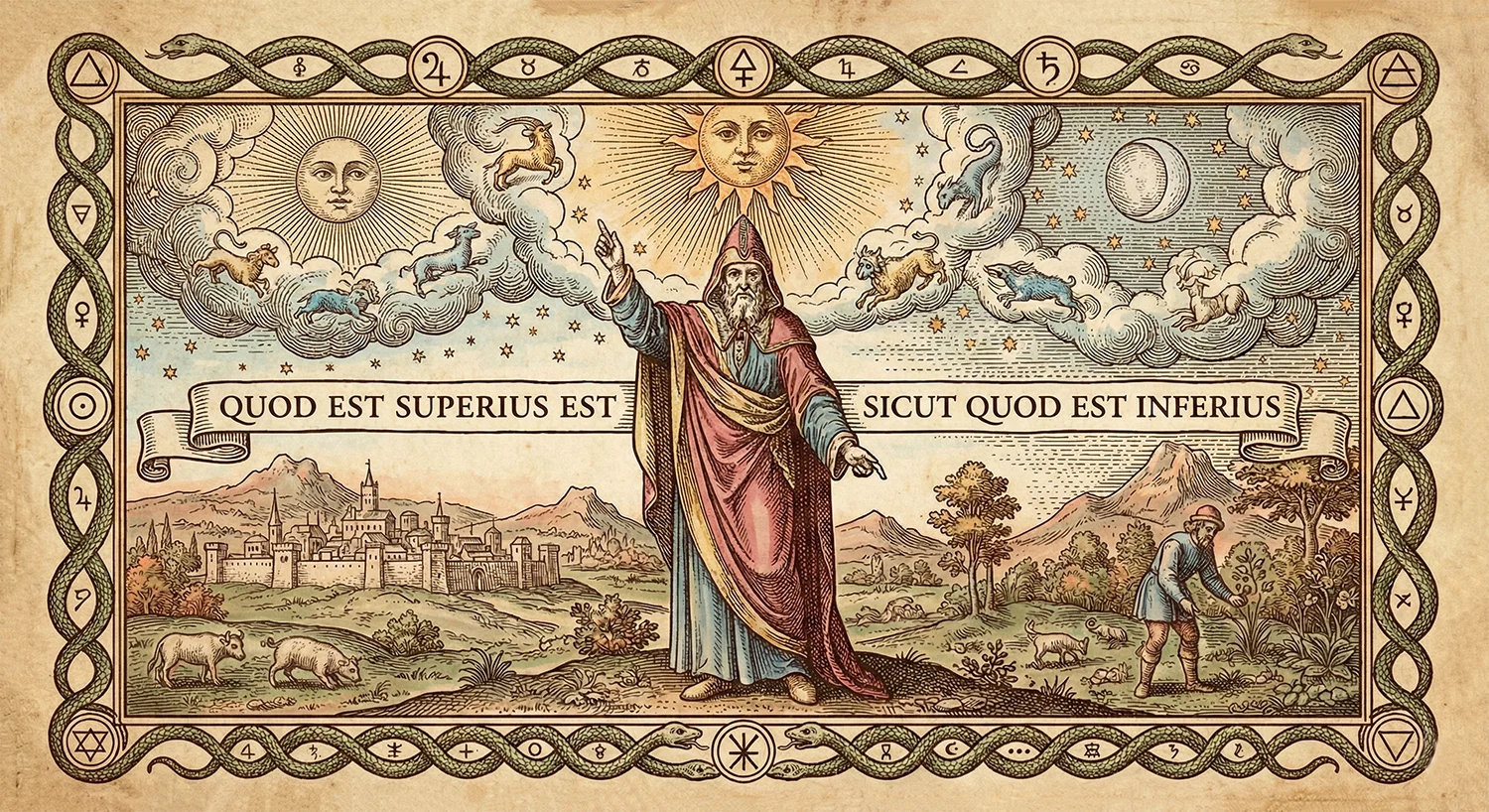
Quod est superius est sicut quod est inferius — “That which is above is like that which is below.” Originating from the Emerald Tablet, this is the central axiom of Hermetic philosophy, affirming the interconnectedness of all levels of reality.
In the engraving above, the heavens reveal three faces: the Sun (Active/Affirming), the Moon (Passive/Receptive), and Mercury (Neutralizing/Reconciling). This ancient triad is a visual representation of what G.I. Gurdjieff called the fundamental law of world-creation: The Law of Three.
“People cannot perceive and observe the third force directly any more than they can spatially perceive the ‘fourth dimension.’” P.D. Ouspensky, In Search of the Miraculous, p84
Valentin Tomberg suggests that Hermeticism is the Third Force—the sacred ‘And’ between Oratory and Laboratory, the living bridge between Religion and Science.
Sacred Middle Way
“Dear Unknown Friend, Christian Hermeticism therefore has no pretension to rival either religion or official science. He who is searching here for the ‘true religion’, the ‘true philosophy’, or the ‘true science’ is looking in the wrong direction. Christian Hermeticists are not masters, but servants. They do not have the pretension of elevating themselves above the holy faith of the faithful, or above the fruits of the admirable efforts of workers in science, or above the creations of artistic genius.” Valentin Tomberg, Meditations on the Tarot, p5
“Hermeticism is not a science … no more is it a religion. It is a uniting—in the inner forum of personal and intimate consciousness—of revealed truth with truth acquired through human endeavor. Being a synthesis—intimate and personal for each person—of religion and science, it cannot rival either the one or the other. The true Hermeticist is one who applies to himself a double discipline—that of the Church and that of Academia. He prays and he thinks. … Ora et labora—‘pray and work’—is certainly his formula, where ‘and’ is the legitimate place of Hermeticism. It is an open door, in the inner forum of his consciousness, between the oratory and the laboratory. It is the door between the two.” Valentin Tomberg, Meditations on the Tarot, p191
Garden of Union
“Here is the essence of the mission of Hermeticism, which is the memory working in the depths of our souls of the primordial and eternal mission of mankind: that of cultivating and maintaining the unforgettable garden of the dawn of mankind. There are ‘trees’ to cultivate and maintain in this garden: the methods or ways of uniting earth and heaven—the rainbow of peace between that which is below and that which is above. … i.e. union through breathing and the circulatory movement of life, union through thought, union through feeling, union through conduct, union through love, union through the magic of the word, and union through the will.” Valentin Tomberg, Meditations on the Tarot, p440
“In so far as we—Christian Hermeticists—are concerned, the ‘trees’ or ‘yogas’ of the garden that we want to cultivate and maintain, are given to us in the ‘seven pillars of the house that Wisdom has built’ (Proverbs ix, 1), i.e. the seven ‘days’ of Creation (including the sabbath), the seven miracles of the Gospel of St. John, the seven ‘I am’ sayings of Jesus Christ and, lastly, the seven Sacraments of the Church. Such are the ‘trees’ of the garden that we cultivate and maintain, i.e. the mysteries of union—mystical, gnostic, magical and Hermetic—of that which is below with that which is above.” Valentin Tomberg, Meditations on the Tarot, p441
Hermeticism as Living Synthesis
“Hermeticism is the life of thought within the whole organism of mysticism, gnosis and magic. Its fundamental law is meditation, i.e. the practice of ‘remembering the sabbath day, to keep it holy’. Meditation is ‘sanctified rest’, where thought is turned towards that which is above.” Valentin Tomberg, Meditations on the Tarot, p297
“Hermeticism is essentially the philosophy, based on magic, gnosis and mysticism, which aspires to the synthesis of the diverse planes of the macrocosm and microcosm. When one summarises facts on a single plane —for example those of biology—one uses the scientific sense and not the Hermetic-philosophical sense. The scientific sense—which is generally known and recognised—summarises the facts of experience on a single plane, in the horizontal. Hermeticism is not a science and will never be one. It can certainly make use of the sciences and their results, but by doing so it does not become a science.” Valentin Tomberg, Meditations on the Tarot, p48
Unity of Truth
“Truth has no other meaning than that of the reduction of the plurality of phenomena to an essential unity—of facts to laws, of laws to principles, of principles to essence or being. All search for truth—mystical, gnostic, philosophical and scientific—postulates its existence, i.e. the fundamental unity of the multiplicity of phenomena in the world. Without this unity nothing would be knowable. How could one proceed from the known to the unknown—and this is indeed the method of progress in knowledge—if the unknown had nothing to do with the known? If the unknown had no relationship with the known and was absolutely and essentially a stranger to it?
“When we say that the world is knowable, i.e. that knowledge as such exists, we state through this fact itself the tenet of the essential unity of the world or its knowability. We declare that the world is not a mosaic, where a plurality of worlds which are essentially strangers to one another are fitted together, but that it is an organism—all of whose parts are governed by the same principle, revealing it and allowing reduction to it. The relationship of everything and of all beings is the conditio sine qua non of their knowability.” Valentin Tomberg, Meditations on the Tarot, p12
The Guardian Heart
“Hermeticism, the living Hermetic tradition, guards the communal soul of all true culture. I must add: Hermeticists listen to—and now and then hear—the beating of the heart of the spiritual life of humanity. They cannot do otherwise than live as guardians of the life and communal soul of religion, science and art. They do not have any privilege in any of these domains; saints, true scientists, and artists of genius are their superiors. But they live for the mystery of the communal heart which beats within all religions, all philosophies, all arts and all sciences—past, present and future.” Valentin Tomberg, Meditations on the Tarot, p6-7
Service Over Conquest
“The ideal of Hermeticism is contrary to that of science. Instead of aspiring to power over the forces of Nature by means of the destruction of matter, Hermeticism aspires to conscious participation with the constructive forces of the world on the basis of an alliance and a cordial communion with them. Science wants to compel Nature to obedience to the will of man such as it is; Hermeticism—or the philosophy of sacred magic—on the contrary wants to purify, illumine and change the will and nature of man in order to bring them into harmony with the creative principle of Nature (natura naturans) and to render them capable of receiving its willingly bestowed revelation. The ‘great work’, as an ideal, is therefore the state of the human being who is in peace, alliance, harmony and collaboration with life. This is the ‘fruit’ of the Tree of Life.
“The motif, method and ideal of Hermeticism is contrary to that of science. The will-to-serve underlies the fundamental Hermetic attitude. Instead of putting forward the hand to take, the human being opens his mind, his heart and his will to receive that which will be graciously bestowed upon him. The inspiration, illumination and intuition that he seeks are not so much conquests accomplished by his will; they are rather gifts from above, preceded by the efforts of the human will endeavouring to become worthy.” Valentin Tomberg, Meditations on the Tarot, p68-69
Symbols as Revelation
“The Hermeticist is essentially an iconophile. For him symbols are not obstacles that must be eliminated in order to arrive at knowledge of the truth, but rather means for receiving revelation. The ‘clothes’—the symbols—of truth are for him not what hides it, but rather what reveals it.” Valentin Tomberg, Meditations on the Tarot, p292
Logion 19
Yeshua says…
Blessed are all who come to live
at the point of arising–
their “genesis,”
before they came into temporality.
If you become my students,
listening deeply to my words,
even these stones will serve you.
And in paradise five evergreen trees await you.
They do not change in summer
nor shed their leaves in winter.
If you come to know them,
you will not know the taste of death.
Logion 77
Yeshua says…
I am the light shining upon all things.
I am the sum of everything,
for everything has come forth from me,
and towards me everything unfolds.
Split a piece of wood, and there I am.
Pick up a stone
and you will find me there.
Quotations from the Gospel of Thomas are from Lynn C Bauman, Ward J Bauman, Cynthia Bourgeault, The Luminous Gospels (Praxis 2008)
Valentin Tomberg, Meditations on the Tarot, Jeremy Tarcher, 1985
Read the Impression Introducing Meditations on the Tarot.
Read the Impression introducing the Gospel of Thomas.
Follow us on Substack

0 Comments