
The Christian hermeticism of Meditations on the Tarot.
This Mt Everest of mystical Christianity had remained shrouded in mist and mystery whenever I approached. After I began this project of writing Impressions, however, I approached by searching for themes, rather than reading from page 1, and the Tarot opened and blossomed. It’s still shrouded, but it sings joyfully in the choir with Cynthia Bourgeault and Maurice Nicoll. Tomberg’s foundational insights resonate with Cynthia’s lived explorations and Maurice’s psychological depths. Where I had two, now I have three, and that feels right.
“The Major Arcana of the Tarot are authentic symbols, i.e. they are ‘magic, mental, psychic and moral operations’ awakening new notions, ideas, sentiments and aspirations, which means to say that they require an activity more profound than that of study and intellectual explanation. It is therefore in a state of deep contemplation—and always ever deeper—that they should be approached. And it is the deep and intimate layers of the soul which become active and bear fruit when one meditates on the Arcana of the Tarot.” Meditations on the Tarot, p4.
The maxim of Christian hermeticism: “that which is above is as that which is below” or “as it is above, so it is below” echoes Cynthia’s teachings on exchange between the realms, and the Gurdjieff teachings that manifestation cascaded down through the realms according to the templates of the Law of Three and the Law of Seven, and Maurice’s teaching that the universe is an ask and response system. Meditations, p13
“An arcanum is a ‘ferment’ or an ‘enzyme’ whose presence stimulates the spiritual and psychic life of man. … if the mentality and morality of the recipient is ready, i.e. if he is ‘poor in spirit’.” Meditations, p4.
“These meditations on the Major Arcana of the Tarot are letters addressed to the unknown friend. … who thereby acquires knowledge … through meditative reading … about Christian Hermeticism.” We, the reader, in the opening sentence of Meditations, become spiritual correspondents, invited into an exchange between the invisible (above) and the incarnate (below).
There is “a series of 22 spiritual exercises—each destined to teach how to find and employ a key to the mystery of the world.” Meditations, p626
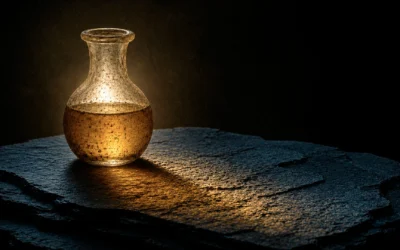
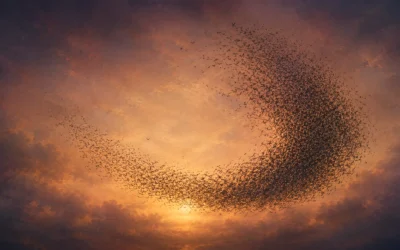
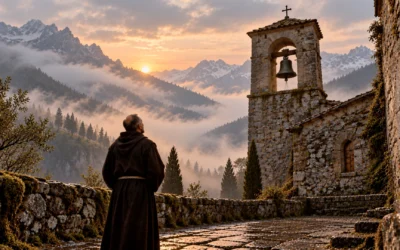
The figure portrayed in the center of the image above is the Magician of Letter I. The Magician might be said to represent creative heart-fire, or in the language of Gurdjieff, the principle of conscious will united with divine will—awake, conscious, receptive, available, changeable. Tomberg refers to the Magician as representing “the principle underlying all the other twenty-one Major Arcana of the Tarot—the rapport of personal effort and spiritual reality.” Meditations, p7.
The figure portrayed on the left of the image above is the Hermit peacemaker of Letter IX, his lantern showing the hidden path, the inner path. Solitary contemplation, wisdom through silence, inner light.
The third figure in the image above is the Angel of Temperance of Letter XIV. She represents the middle way, the capacity to blend opposing forces. Maurice would say to stand between the opposites—the only place that Third Force will reach us. I like to think of it as the complex interplay between active and passive.
There are some major themes in Meditations that I sense as being reflected in the teachings of Cynthia and Maurice:
- three stages of purification, illumination, and union
- the relationship between vertical and horizontal respiration
- visible and invisible worlds in constant exchange
- concentration without effort, contrasting with analytical study
- creative tension and integration of opposites
- as above, so below—reflecting Gurdjieff’s Ray of Creation and Law of Three
Logion 22
Yeshua noticed infants nursing
and said to his students,
“These little ones taking milk
are like those on their way into the kingdom.”
So they asked him,
“If we too are ‘little ones’
are we on our way into the kingdom?”
Yeshua replied,
“When you are able to make two become one,
the inside like the outside,
and the outside like the inside,
the higher like the lower,
so that a man is no longer male, and a woman, female,
but male and female become a single whole;
When you are able to fashion an eye to replace an eye,
and form a hand in place of a hand, or a foot for a foot,
making one image supersede another —
then you will enter in.”
Valentin Tomberg, Meditations on the Tarot, Jeremy Tarcher, 1985
Quotations from the Gospel of Thomas are from Lynn C Bauman, Ward J Bauman, Cynthia Bourgeault, The Luminous Gospels (Praxis 2008)
Read the Impression introducing the Gospel of Thomas.

0 Comments