
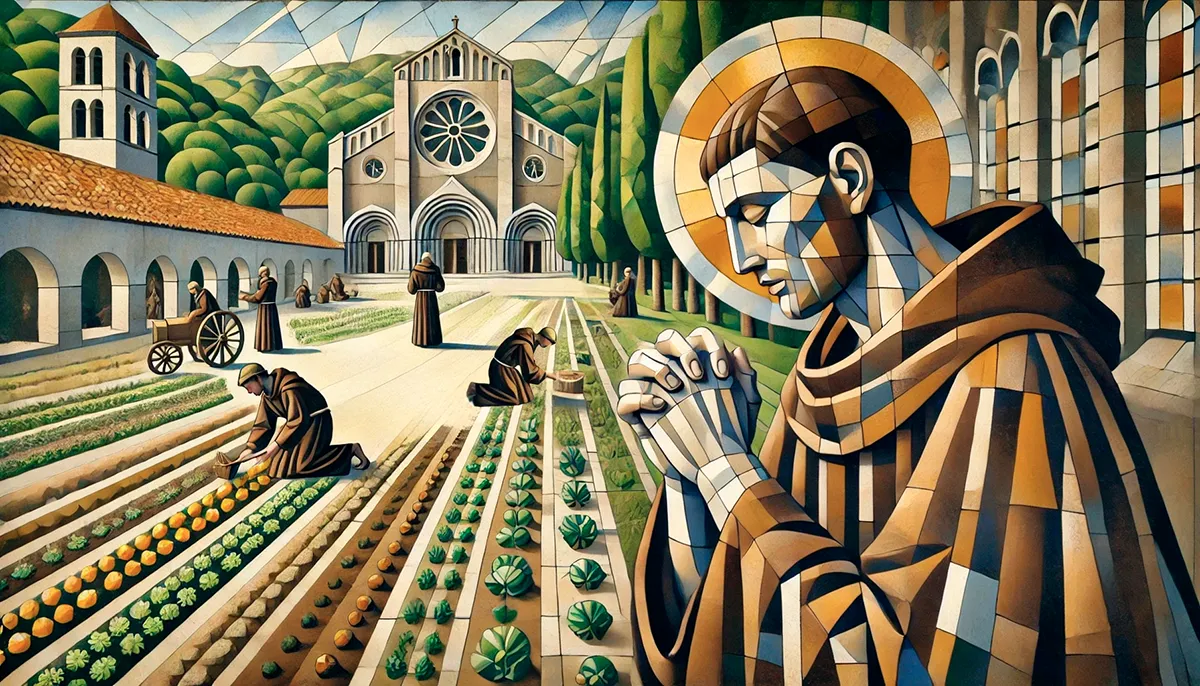
Ora et Labora … no transformation without washed dishes!
Ora et Labora: The Benedictine Foundation
“It is humility alone, due to poverty, obedience and chastity—the three universal and eternal vows which renders us ‘inspirable’. It cannot be helped…the spiritual world is essentially moral. And inspiration is the fruit of humility in effort and of effort with humility. Ora et labora is therefore the key to the door of inspiration, as it is the key to many other doors besides.” Meditations on the Tarot, p393-394.
“It’s all based on the Benedictine rhythm of Ora et Labora—working together and praying together. And all of that is in service of remembrance, remembering who we are and remembering that we belong not only to this world, world 48, but that we belong to worlds beyond. We belong to world 24, to the kingdom of heaven or the Imaginal realm. And so the goal of monastic rhythms is not efficiency. It’s about presence and remembrance.” Cynthia Bourgeault, Encounter with Evil Feb 2023 CA, 32:52 Day 0 Introductory Teaching.
“From the Benedictine tradition, we got the wonderful pieces of Ora et Labora, Prayer and Work. The idea of setting up a day and a week and a lifetime in a rhythmic balance that rotates between times of activities that you call prayer, meditation, chanting, devotion, inner inquiry, all that stuff that grows the being deeper. And then the part of the work called Labora, or conscious work.The work that is required to keep our human body and soul on the planet. The gospel according to Bob Sabbath—no transformation without washed dishes!” Cynthia Bourgeault, Claymont 2014 Jacob Boehme, 11:08 1.TuesEve.GWS14.
“Saint Benedict in the 5th century was drawing on an already well-established stream of transformational wisdom that came out of the deserts of Egypt and Syria by a first generation of people that really wanted to practice what it means to put on the mind of Christ. Saint Benedict became heir to this and shaped it into a massive stable container which has been the foundation of Christian monasticism and monastic transformational practice in the West for 1500 years. And so it’s brilliant stable legacy of Ora et Labora, prayer and work as a fundamental rhythm for the balancing and ordering of human life and for the growing of that beautiful rose of wisdom. That’s the Benedictine contribution.” Cynthia Bourgeault, Kanuga 2015, 12:25 0.1a First Evening Welcome & Introduction Part 1 of 2.
“That tradition, that oral transmission of living wisdom from desert Abbas and Ammas, spiritual elders, got transmitted to the western shores of the Mediterranean beginning about the 5th century. And finally took form as in the monastic tradition founded by St. Benedict in the early 6th century, which has become the taproot in the Christian West for the transmission of the practices that help support a greater consciousness. And what Benedict did was to divide a day for the people who became monks into two halves, Ora et Labora he called it, prayer and work. And people would engage every day in an intentional and rhythmic movement back and forth between prayer, roughly divided between prayer alone, you know, on your cushion, you know, meditating, reciting and pondering scripture, and prayer, chanting, chanting the psalms basically. It revolved between that and then doing manual labor.” Cynthia Bourgeault, Stonington June 2016 Teilhard, 46:00 2016-06-07b Tuesday Evening Introduction to Wisdom School.
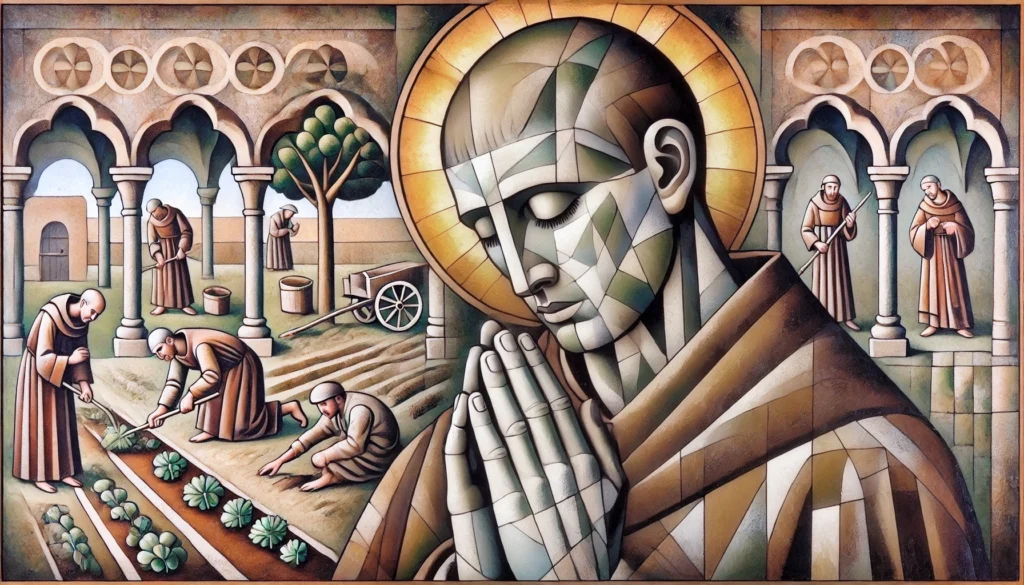
Rhythm and Balance of Ora et Labora
“If you really get the rule of St. Benedict right, you realize that the Ora et Labora is a perfect breathing. And that if you’re doing it correctly, your Labora doesn’t wear you out. Nor does your Ora. You learn to breathe it and give yourself fully to whatever you’re doing.” Cynthia Bourgeault, The Divine Exchange, 2:29 Divine 05-10.
“When Jesus says you should be in this world but not of it, if you translate that into meaning, if you can live in World 48 according to the causality of World 24, you will do good on this planet.” Cynthia Bourgeault, Imaginal WS 8-2020, 11:00 0819 IWS Wednesday PM Teaching.
Inspiration and Transformation Through Ora et Labora
“The ancient saying ‘Ora et Labora’ (‘work and pray’) constitutes the only answer that I have been able to find. Worship and work constitute the only curative as well as prophylactic remedy that I know against megalomaniacal illusions. It is necessary to worship what is above us and it is necessary to participate in human effort in the domain of objective facts in order to be able to hold in check the illusions concerning what one is and what one is capable of. For whoever is aware of raising his prayer and meditation to the level of pure worship will always be conscious of the distance which separates (and at the same time unites) the worshipper and the worshipped. Therefore he will not be tempted to worship himself, which is in the last analysis the cause of megalomania. He will always have in sight the difference between himself and the worshipped.” Valentin Tomberg, Meditations on the Tarot, p161-162.
“Inspiration is activity and passivity—or effort and grace simultaneously. Grace and human effort—Ora et Labora.” Valentin Tomberg, Meditations on the Tarot, p396.
Logion 81
Yeshua says...
Let whoever becomes rich be king,
but let whoever holds power surrender it.

Logion 27
Yeshua says...
If you do not fast from the cosmos,
you will never grasp Reality.
If you cannot find rest on the day of rest,
you will never feast your eyes on God.
Valentin Tomberg, Meditations on the Tarot, Jeremy Tarcher, 1985
Quotations from the Gospel of Thomas are from Lynn C Bauman, Ward J Bauman, Cynthia Bourgeault, The Luminous Gospels (Praxis 2008)
Read the Impression introducing the Gospel of Thomas.



0 Comments