
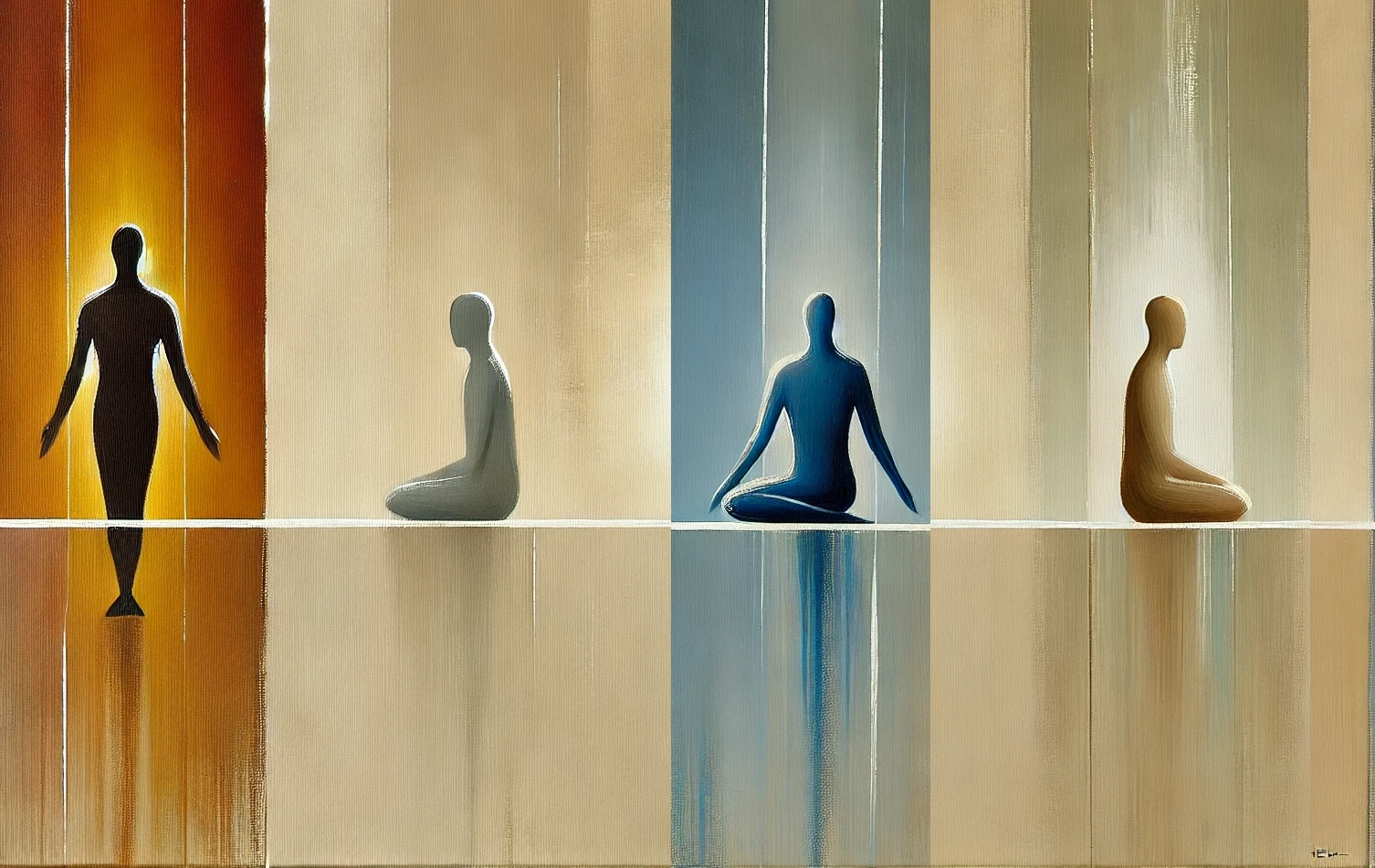
Finding a center of gravity within: how to know your True Self, or Essence.
“The center of gravity is the seat of unity.” Jeanne de Salzmann, The Reality of Being, p130
“By the force of my attention actively turned inward, the movement of energy changes. Instead of going outside, it concentrates within until it forms the center of gravity of my Presence. My whole effort, my whole work, is to maintain this direction— to maintain a body so relaxed that the energy does not leave, a thinking turned toward myself so vigilant that its very presence sustains the stillness of my body, and a feeling of what wants to be recognized, of what is here, a feeling of ‘I’.” Reality of Being, p132
“My center of gravity is the central point between a descending and an ascending movement. It is neither my heart nor my head, but it gives them such freedom that it allows a blending with the higher centers.” Reality of Being, p230
“The concept of Man in this teaching is divided into seven categories to begin with: No. 1 Man, whose center of gravity is in his instincts and movements, in his physical life, then No. 2 Man, whose center of gravity is in his emotional life, then No. 3 Man whose centre of gravity is in his intellectual life. These three categories form mechanical humanity, the outer circle of mankind, who do not understand one another. As you know, this is called the circle of the confusion of tongues, the circle of Babel. Then there is No. 4 Man whose centre of gravity is not in the Instinctive-Moving Centre nor in the Emotional Centre nor in the Intellectual Centre but as it were distributed among them. This is the balanced man, in whom development is no longer one-sided and in whom awakening has begun.” Maurice Nicoll, Psychological Commentaries, p145
“In consequence of the formation of personality your centre of gravity of consciousness shifts from essence (in childhood) outwards into the personality acquired from the particular circumstances you are brought up in and the particular things that have interested you on the one side or have attracted your vanity on the other side. In this way, you, as it were, lose your original basis and become something acquired, something invented. All this is necessary, but it gives a wrong centre of gravity.” Commentaries, p274
“Take a man whose centre of gravity is in the Intellectual Centre. He is only interested in theories and abstractions.” Commentaries, p174
“Our moods are all hung on to pendulums. We should not trust them. Unfortunately we identify with them. We take them as ourselves. We say: “I feel”, “I think”, and so on. We forget that “Real I” is in the center of the pendulum-swing, and we allow ourselves to swing between excitement and dejection, between enthusiasm and depression, between over-valuation and undervaluation, between conceit and humility, and so on, endlessly. In all this, there is no center of gravity.” Commentaries, p328
“The just man is between the opposites, in a state of equilibrium. By knowing how to withdraw force from the opposites, his center of gravity is not pulled to one side or the other. This is only possible by reaching a definite feeling of one’s own nothingness. To feel one is something prevents one from reaching a position between the opposites.” Commentaries, p329
“If there is valuation [of the Teachings] and if in spite of all difficulties we can feel that here is something that can eventually lead us away from our present states, and if in spite of all the failures this valuation persists, then a center of gravity will be formed, a point in the Work will be established, and when this is so it is a very blessed condition. Commentaries, p370
“What does it mean to be bound by something internal? In the first place it means that such a person will always maintain a certain integrity quite apart from outer circumstances. He will have a center of gravity in himself.” Commentaries, p446
“The center of gravity of the Will is in the Emotional Centre—this centre that it is the object of the Work to awaken and which works so badly in us as we are at present.” Commentaries, p483
“Everyone has an eternal center of gravity, but, being swayed by the senses, by the feeling that they are nothing but their bodies and by the impact of impressions coming from external life, they get far away from this center of gravity. Self-Remembering is the beginning of the attempt to bring us back into ourselves and so into our real centre of gravity. That is why a very external person who is simply governed by the effect he or she makes on other people has a very great difficulty in understanding what Self-Remembering means, and indeed what this Work means.” Commentaries, p535
“The dark side of ourselves is very great, but when the light of self-observation is thrown into this dark side, consciousness of ourselves increases through self-knowledge, and after a time we begin to feel differently from what we used to feel. The centre of gravity of ‘I’ in us begins to change.” Commentaries, p832
“There is a kind of innocence in small children which they lose very soon through identifying. This innocence, if we can call it so, belongs to Essence, but soon it becomes surrounded by Personality and False Personality, and we lose our original centre of gravity which passes from Essence into Personality. We then become, so to speak, invented people carrying on a fictitious life.” Commentaries, p899
“One must get this vision—in which the centre of gravity of the whole Work lies—a vision of the Work that lifts us above life—in short, this Rope which we have to catch hold of. Hold this Rope, when you catch it.” Commentaries, p972
“To attempt to do this Work—such as the practising of non-identifying—without willing the Work cannot give any result. Will starts from affection. Will, if you come to think of it, is love. One emotion can overcome another if strong enough. The centre of gravity of Will lies in the Emotional Centre. It is worth reflecting on this oneself. Commentaries, p994
On p1088 in the Commentaries, Maurice devotes the entire talk to the idea of Center of Gravity. “The passage from the mechanical to the Conscious Circle of Humanity is impossible without the help of something different from Life and its daily stresses and strains. So the Work is called a different 3rd Force from Life. Let us speak of this second meaning of Centre of Gravity which must begin with Point in the Work—that is, a genuine feeling that the Work is important. A point in the Work begins with evaluation.” Maurice continues with a discussion of ‘making moon’ in ourselves as a way to shift our center of gravity.
“Let us try to understand this in easier terms. Not one of us, as we are mechanically in life, has his or her centre of gravity in Real ‘I’. We have it in False Personality, in Imaginary ‘I’, in a fiction of ourselves that we have to keep going.” Commentaries, p1261
“Work little by little so that we can withstand the shifting scene, moments of happiness followed by moments of depression, moments of hope followed by moments of despair, in order that we may have a centre of gravity within ourselves so that we are not shaken because now we feel happy and the next moment we feel unhappy. After a time you will come to the point when you do not mind whether you are happy or not because you want to keep in yourself a certain point of consciousness that is invulnerable. This is the beginning of the birth of Real I in you.” Commentaries, p1343
“Since Essence descends from a ‘high place’ and becomes ultimately encased in a body of flesh and bones, an ascending octave must exist in Man connected with this descent. The idea here is that Essence having descended may be able to re-ascend—that is, to retrace the path of its descent. If Essence re-ascended and the centre of gravity of a man’s consciousness and being were truly situated in Essence instead of in Personality, then the re-ascent of Essence would be the ascent of the man also to the level of his origin. It would be the return journey.” p1615
“The possibility of inner growth is of opening to a new functioning that can connect the different centers. The thought needs to become independent in order to keep the idea of self-remembering, a remembering that passes to the moving center, then to the emotional center, and from there connects with the higher centers. For this there must be an inner center of gravity. I need to see what this requires.” Jeanne de Salzmann, The Reality of Being, p136
Logion 37
His students asked him,
"When will you manifest yourself to us?
How long will it be
before we see you as you truly are?
Yeshua replied,
"On the day you strip yourselves naked
like those little children,
and take your clothes and trample them
on the ground under your feet without shame,
then you will be able
to look upon the son of the Living One
without fear."

Logion 28
Yeshua says...
I stood to my feet in the midst of the cosmos,
appearing outwardly in flesh.
I discovered that all were drunk
but none were thirsty,
and my soul ached for the children of humanity,
for their hearts are blind.
They cannot see from within.
They have come into the cosmos empty,
and they are leaving it empty.
At the moment you are inebriated,
but when freed from the effects of wine,
you too may turn and stand.
Read other Impressions on Essence.
Page numbers for Maurice Nicoll refer to Psychological Commentaries on the Teachings of Gurdjieff and Ouspensky (Eureka Editions:2020) unless stated otherwise.
All quotations from the Gospel of Thomas are from Lynn C Bauman, Ward J Bauman, Cynthia Bourgeault, The Luminous Gospels (Praxis 2008)
Jeanne De Salzmann, The Reality of Being, Shambhala Publications, 2010
Read the Impression introducing the Gospel of Thomas.



0 Comments