
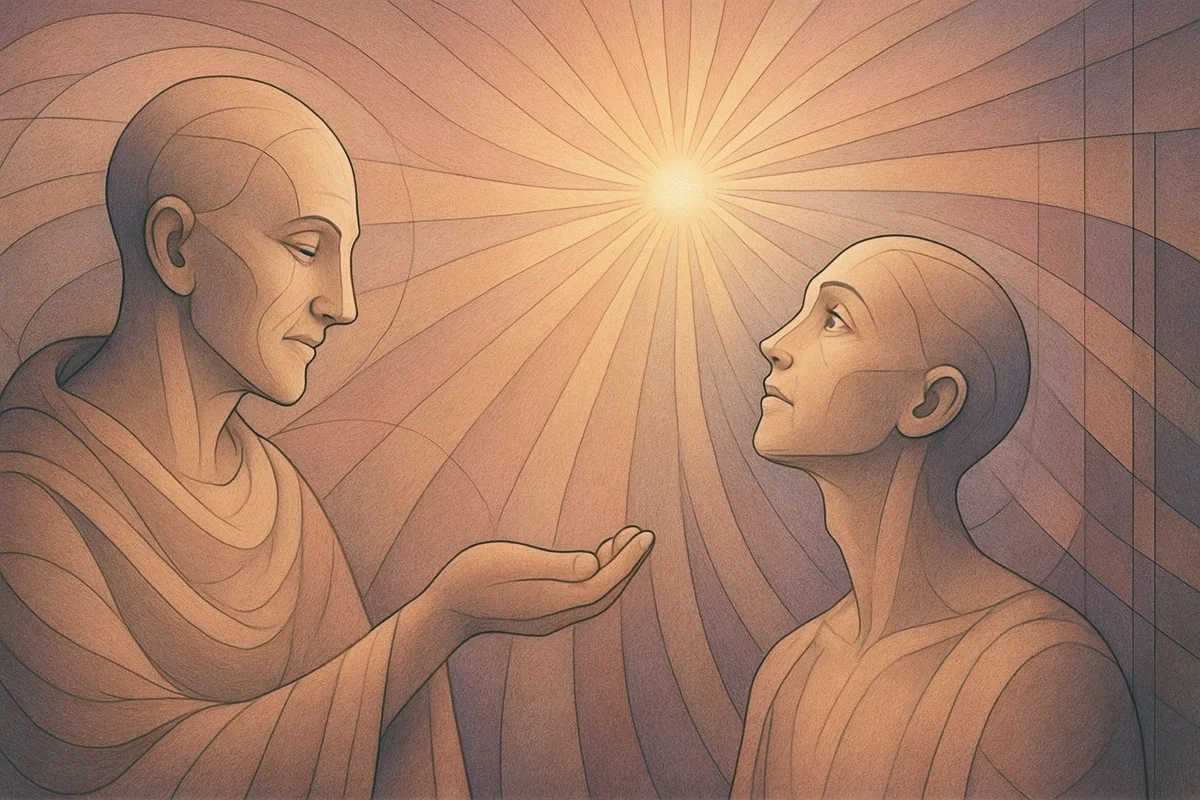
“Unless you cancel your debts, nothing in you can grow. It is said in the Lord’s Prayer: ‘Forgive us our debts as we forgive our debtors.’ Feeling you are owed, feeling debts, stops everything.” Maurice Nicoll
Debts and Debtors
The Heaven-Earth Balance
Grace operates by different justice than law. As real as gravity, and just as implacable. What you hold binds you. What you release releases you.
“‘Gratia gratis data…’ The sun shines on the good and wicked alike. Is this morally right? Is it the justice of grace here which is higher than the protective, distributive and punitive justice of the law? This is so. There is the sublime ‘other justice’ of grace, which is the meaning of the New Testament. For the Old Testament is to the New Testament as karma is to grace. Grace also makes use of the balance, i.e. justice. It is the balance whose one scale is on the earth and whose other scale is in heaven.” — Valentin Tomberg, Meditations on the Tarot, p 178-179.
The Lord’s Prayer reveals this balance explicitly:
“The Lord’s prayer reveals to us the principle of the justice of grace and the operation of weighing by means of the ‘heaven-earth’ balance. There it is said: ‘Forgive us our trespasses, as we forgive those who trespass against us.’ And then the Master adds: ‘For if you forgive men their trespasses, your heavenly Father also will forgive you; but if you do not forgive men their trespasses, neither will your Father forgive your trespasses’ (Matthew vi, 12, 14-15).
“The Master is explicit with respect to the balance operating between earth and heaven—’…if you do not forgive men their trespasses, neither will your Father forgive your trespasses’—this is the law, this is the infallible and implacable operation of the ‘heaven-earth’ balance.” — Valentin Tomberg, Meditations on the Tarot, p 179.
Cosmic mechanics: The scale that touches earth must correspond to the scale in heaven.
What We Owe, What Is Owed
Everyone in relation to higher truth is a debtor.
“Everyone who remains in ignorance of the idea of higher truth is regarded in the Gospels as a debtor, and although higher truth has always been sown into the world and people have read it, they do not understand it — and for this reason, in the following Parable of Lazarus, Christ says that even if a man were to rise from the dead, people would not repent, that is, undergo any transformation of mind (Luke xvi.31). ‘Neither will they be persuaded, though one rose from the dead.'” — Maurice Nicoll, The Mark, p. 162.
The debt isn’t moral failure—it’s unrealized possibility.
“Men are regarded as debtors in relation to higher truth – that is, to a higher possibility in them. If a man remains inferior to himself, he owes to himself, and so is a debtor to himself. If, for example, a man knows better but acts worse, he owes himself – that is, he is in debt to his better nature and his better understanding. This makes everyone unhappy, because most people feel this about themselves, only they do not really know where they owe, or about what they are in debt to themselves. But from the standpoint of the Gospels, where it is taught that a man must undergo an inner evolution beginning with metanoia and ending in re-birth and the Kingdom of Heaven, everyone without exception is regarded as a debtor.” — Maurice Nicoll, The Mark, p 162.
What you owe is what you have not done. Not sins committed—potential unrealized.
“In the original Greek, it is not said: ‘Forgive us our sins’, in the Lord’s Prayer, but ‘Cancel what we owe (in proportion) as we cancel what others owe us.’ Notice that emphasis not on what we have done but on what we have not done. This means that if, say, I never remember myself, I owe my Father who is in Heaven and continue to owe more and more as my life of being asleep goes by. I may worry intermittently about some things I have done but this is quite different from reflecting on things I have not done.” — Maurice Nicoll, Psychological Commentaries, p. 1587.
The Psychology of Internal Accounts
Feeling others owe you creates psychological imprisonment.
“All feelings that you are owed by other people and that you owe nothing yourself, are of very great psychological consequence to the inner development of a man. A man in the Work can only grow through the forgiveness of others. That is, unless you cancel your debts, nothing in you can grow. It is said in the Lord’s Prayer: ‘Forgive us our debts as we forgive our debtors.’ Feeling you are owed, feeling debts, stops everything. You hold back yourself and you hold back the other person.” — Maurice Nicoll, Psychological Commentaries, p 253.
You keep an account book in memory—a ledger of grievances.
“Then comes the request to be forgiven, as we forgive others; and this means that to reach a higher level it is absolutely necessary first of all to cancel the debts of others recorded in that account book we all keep in our memories of what we imagine we are owed by the bad behavior of others to us and their lack of consideration to ourselves. Not to forgive others is to keep oneself held down and chained to the ‘earth’. We imprison ourselves, fasten ourselves down, keep ourselves where we are, if we cannot cancel debts, and as we forgive others so we are forgiven for our innumerable mistakes, failures in the growth of our own understanding—that is, in our own evolution.” — Maurice Nicoll, The New Man, p 137-138.
This produces inner paralysis:
“The psychological result of making accounts against others is the feeling that other people owe us. Other people are in debt to us. This produces a very bad inner state from which the development of any individuality is impossible. … All these inner accounts must be cancelled. The Lord’s Prayer says literally: ‘Cancel our debts in proportion as we cancel other people’s debts.’ Now if you cannot cancel what you believe are other people’s debts you will not have debts cancelled for you through the action of the Work on you. This means that your whole relation to the Work will be wrong—it will be a bad relation.” — Maurice Nicoll, Psychological Commentaries, p 571-572.
Beyond Knowledge to Feeling
Forgiveness requires emotional development, not intellectual understanding.
“Because Peter was a man of knowledge and not yet emotionally awake, he could not forgive. To forgive comes from emotional development. Only through emotional development can we cancel the debts of others. All emotional development means to develop beyond self-love and all its absorbing interests, to the stage of ‘love of neighbor’.” — Maurice Nicoll, The New Man, p 119.
Truth alone condemns. Only mercy finds a way out.
“When a man has the love of goodness in him he does not judge from the love of Truth alone. The man of Truth is morose and gloomy. He sees everything logically. And Truth alone judges us all and condemns us all. Only mercy can find a way out, and that mercy must begin with others: ‘Forgive us as we forgive others’, as it is said in the Lord’s Prayer.” — Maurice Nicoll, The New Man, p 120.
The Transformative Power of Canceling Debts
The unjust steward’s wisdom: taking on yourself what others owe.
“The plan that the steward carried out towards the least – that is, the unrighteous Mammon, and so the debtors – is therefore connected, by Christ’s comments on the parable, with the idea of being faithful. And the plan is that the steward resolves to forgive some of the debts owed by the ‘sons of the world’ by telling them and giving them his authority to write down their debts by so much. And the extraordinarily deep meaning here contains the sense also that he takes on himself something of what they owe. He makes himself responsible for part of their shortcomings and in this way makes everything more possible for them. This is being faithful in the least, for the idea of faith in the Gospels is often connected with the power of making all that belongs to the world less than it is. In the Gospels by the power of faith is always meant a transforming power. The steward is faithful in the least, therefore, because he transforms the situation of some of the debtors.” — Maurice Nicoll, The Mark, p. 165.
This is faith as transformative power: making what belongs to the world less than it is by absorbing some of what others owe.
Practical Work: Altering Memory
Self-observation transforms the account book.
“One of the most important ways of altering memory is by cancelling debts through seeing the unpleasant things we attribute to others as also existing in ourselves and this is one of the great uses of self-observation. This checks the growth of unpleasant memories and also changes us. This kind of work on yourself is always possible at any moment wherever you are, and begins as soon as you reach the stage of being able to notice when you are taking in unpleasant impressions either from outside or from memory.” — Maurice Nicoll, Psychological Commentaries, p 589.
The translation matters: not “forgive” but “cancel completely.”
“The state that is mentioned in the Lord’s Prayer of being able to cancel the debts of others against him completely, for this is the real meaning of the Greek word translated as forgive in the phrase ‘forgive us our debts as we forgive others’. No, the meaning is far more powerful than that, far more practical. The meaning is cancel completely. From this we can see how close the teaching of the Work about not making internal accounts comes to what is said also in the Gospels.” — Maurice Nicoll, Psychological Commentaries, p 728.
Liberation from Earth-Binding
All Earth-problems must be cancelled to rise.
“We have often spoken about forgiving debts and about how it means cancelling complaints against others. All our Earth-problems are of no value at all at a higher level of Being, and our work is to cancel our Earth-problems, our Earth-suffering, our internal accounting, our negative states towards others, our grievances towards others, our dislike of others and our hate of others. Otherwise we are earthbound.” — Maurice Nicoll, Psychological Commentaries, p 854.
Holding accounts keeps you chained to earth. Canceling them is how the heaven-earth balance operates—the scale moves only in proportion.
The Gratuitous Gift
This entire economy of debt and forgiveness reveals something about the divine heart:
“The idea is that the anger basis of atonement theology is removed in the gentler and kinder versions, and what’s substituted is a sadness version, and that God identifies with us and the son was sent as a gift, and the gift was not just to pay our debts in a kind of nickel-and-dime kind of way, but as a gratuitous revelation of the divine heart. So across the board, Jesus Christ is somehow understood to be the algebraic solution to this irreducible koan of how can God be good and powerful, and yet there’s evil in the world.” — Cynthia Bourgeault, Encounter With Evil April 2023 NC, 11:15 02a-Monday am Teaching Evil.
Not transactional payment. Gratuitous revelation. The gift shows you how the balance actually works—through mercy, not arithmetic.
Logion 41
Yeshua says…
To the one who has something in hand,
more will be given.
To the one whose hands hold nothing,
even that “nothing” will be taken away.
Logion 95
Yeshua says…
If you have money, do not lend it at interest.
Give it instead
to someone from whom you cannot take it back.
Page numbers for Maurice Nicoll refer to Psychological Commentaries on the Teachings of Gurdjieff and Ouspensky (Eureka Editions:2020) unless stated otherwise.
Quotations from the Gospel of Thomas are from Lynn C Bauman, Ward J Bauman, Cynthia Bourgeault, The Luminous Gospels (Praxis 2008)
Valentin Tomberg, Meditations on the Tarot, Jeremy Tarcher, 1985
Read the Impression introducing the Gospel of Thomas.
Read the Impression on Meditations on the Tarot.




0 Comments