
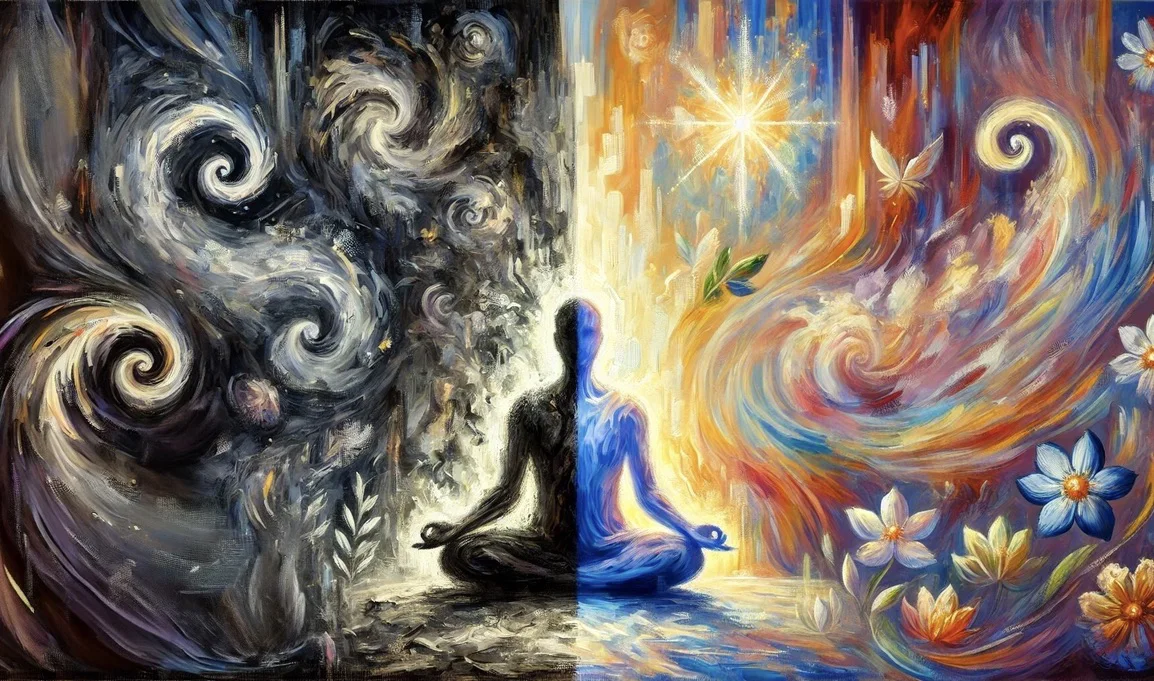
Maurice Nicoll talks of spiritual awakening levels and change of Being.
“Being is the presence in a person, however fleeting, of Second Body.” Cynthia Bourgeault
The Fundamental Work
“The whole of this work is about a change of being—that is, a change of the level of being at which a man naturally is—in ordinary life.” Maurice Nicoll, Psychological Commentaries, p2
“Your Being cannot change if you do not become more conscious of it. How could it? Your level of Being and your level of consciousness are closely connected.” Commentaries, p1226
“The Work says that to change Being is to change Essence and not Personality. If you can get a development of Essence by making Personality passive in one direction or another, the energy that would otherwise go into your acquired Personality would be deflected into Essence and cause a growth of Essence. This growth of Essence is called change of Being in the real sense.” Commentaries, p1424
Beginning with Daily Reactions
“Change of being begins with changing your reactions to actual incidents of the day. This is the beginning of taking your life in a real and practical sense in a new way.” Commentaries, p26
“Where you reacted mechanically, now you see and begin to act consciously. This is a change of being.” Commentaries, p1049
Through Increased Consciousness
“Literally, consciousness means ‘knowing together’. Self-knowledge means to become more conscious, first of the different contradictory ‘I’s, different moods, etc., and to know them together. This signifies increase of consciousness in the sense of knowing together. Change of being can only take place through this method—namely, an increase of consciousness in this sense.” Commentaries, p203
“The Work says that self-observation is a method of change of Being. This is a very important thing to understand and it may take years before one catches a glimpse of its meaning.” Commentaries, p599
“To observe “yourself” you must observe it sincerely. Self-observation must necessarily have a certain detachment from oneself and this is the beginning of change of being. It is the gateway into this Work. If you take for granted everything you do, everything you feel, everything you think, you are not observing yourself. That is called being a mechanical man or woman; and you suffer uselessly all your life, not understanding what you have to do in life. The Work says we must observe ourselves sincerely.” Commentaries, p1331
Inner Sincerity and Valuation
“The Work is based on inner sincerity. One effort arising out of inner sincerity and unshakeable valuation of the Work will produce a change of being and shift a man’s position in the universe because it is qualitative, different from any quantity of external, insincere or weak efforts.” Commentaries, p206
What Prevents Change
“Mechanicalness and sleep prevent change of being.” Commentaries, p334
“Try to see the basis of your self-satisfaction. You will understand that unless this basis is completely broken up there can be no change of being.” Commentaries, p338
“The psychological result of making accounts against others is the feeling that other people owe us. Other people are in debt to us. This produces a very bad inner state from which the development of any individuality is impossible. That is why in the Lord’s Prayer so much is said about this in such a condensed way. As long as we feel that others owe us—i.e. as long as we persistently make inner accounts—we cannot start any change of being or reach any new understanding.” Commentaries, p571
“A person in this Work, the object of which is increase of consciousness and so change of Being, cannot proceed beyond a certain point unless they halt negative impressions of others.” Commentaries, p1001
What Must Be Sacrificed
“You cannot be what you are and at the same time change. Change of Being always involves giving up something and so sacrificing something in your Being. And the Work says that the first thing that you have to sacrifice is your ordinary mechanical suffering.” Commentaries, p850
“A Conscious Man can not have a will founded on self-love. A Conscious Man is a man who has undergone a change of being—actually a transformation of being. As it was pointed out to you in recent papers, no change of being is possible as long as the self-love remains unchanged; and as long as the self-love remains the same, the self-will remains just what it was.” Commentaries, p1609
Seeing Contradictions
“To change your being you have to begin to realize contradictions in yourself by direct, uncritical self-observation.” Commentaries, p964
The Three Lines of Work
“There can be no change of being without an alteration in the ordinary feeling of ‘I’. The Three Lines of Work speak of this—work on oneself, work in connection with others and making new relations with them, and work for the sake of the Work itself.” Commentaries, p983
Being Attracts Life
“If Essence grows, when it is re-born it will not attract the same life. Change of Being necessarily means a change in the life because one’s Being attracts one’s life.” Commentaries, p419
The Trouble Is in Yourself
“I advise here one thing only: if your doubts and distress are connected with anyone external you will never pass this interval. You have to see in some way that the trouble is really in yourself and is due to buffers, attitudes, habits of mind, etc. The Work is about change of being. Change of being is change of yourself.” Commentaries, p515
Knowledge Must Precede
“Knowledge must precede change of being. That is, through knowledge of one’s being one can begin to separate from certain elements in it, so that eventually one has changed being so that it does not attract the same things as formerly. But this metamorphosis only begins through metanoia or change of mind, because, if there is no change of mind or new knowledge, there can be no metamorphosis or change of being.” Commentaries, p1441
Standing the Increase
“It is not pleasant but how can anybody expect to gain an increase of consciousness without being prepared to stand it ? We resent every sort of reproof. We are so easily hurt that we are offended at the least thing that touches our self-love. Of course, we do not see all this. We imagine quite otherwise. But can you not see that this is the crux of the whole business of change of being?” Commentaries, p1520
The Four Practices
“Self-Observation, Self-Remembering, Non-Identifying and Non-Considering can change a person’s being if they are practised.” Commentaries, p1702
Logion 22
Yeshua noticed infants nursing
and said to his students,
"These little ones taking milk
are like those on their way into the kingdom."
So they asked him,
"If we too are 'little ones'
are we on our way into the kingdom?"
Yeshua replied,
"When you are able to make two become one,
the inside like the outside,
and the outside like the inside,
the higher like the lower,
so that a man is no longer male, and a woman, female,
but male and female become a single whole;
When you are able to fashion an eye to replace an eye,
and form a hand in place of a hand, or a foot for a foot,
making one image supersede another --
then you will enter in."

Logion 61
Yeshua says...
Two will be resting on a bed.
One will die, the other will live.
Salome said,
"Then how is it, Sir,
that you, coming from the one Source,
have rested on my couch and eaten at my table?"
Yeshua said to her,
"I am he who has appeared to you
out of the Realm of Unity,
having been granted
that which belongs to my Father, its Source."
"I will be your student!" she exclaimed.
"Then I say this to you:
if you become whole you will be full of Light.
If you remain fragmented darkness will fill you."
Page numbers for Maurice Nicoll refer to Psychological Commentaries on the Teachings of Gurdjieff and Ouspensky (Eureka Editions:2020) unless stated otherwise.
All quotations from the Gospel of Thomas are from Lynn C Bauman, Ward J Bauman, Cynthia Bourgeault, The Luminous Gospels (Praxis 2008)
Uncited quotations from Cynthia Bourgeault are from The Vocabulary of Wisdom.
Read the Impression introducing the Gospel of Thomas.




0 Comments