Cynthia Bourgeault’s teachings on dying to self: from cosmic law, through the experiential portal, into the two-threshold teaching, ending with the radical vision of love-as-squandering.
The Law: Dying as the Shape of Growth
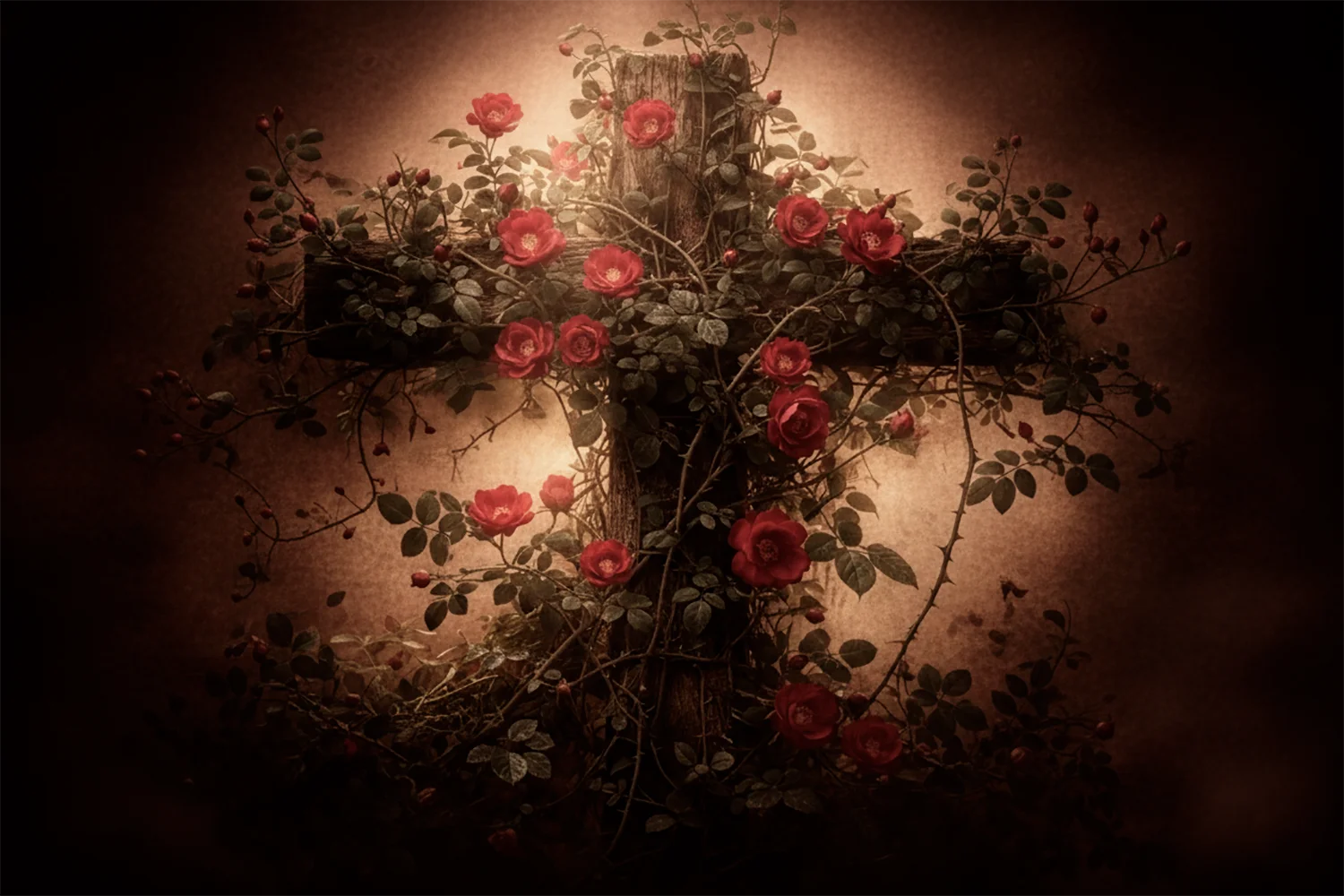
“Above all I would most love to see here the Tree of Death and Resurrection—the Cross from which the Rose springs. This is the Cross that is mortifying and vivifying at the same time—the Cross where the agony of Calvary and the glory of the Resurrection are united. For the Cross is the law of growth: that of perpetual dying and becoming. It is the way which does not lead to impasses of specialization, but rather to ‘throughways’ of purification—which lead to illumination and end in union.”
Valentin Tomberg, Meditations on the Tarot, p451
“Love and death have something in common in the respect that love is a dying to self. And this dying is accessed not by renunciation, but by total self-outpouring. Not by holding back, but by total giving until there’s nothing left. So, that’s what love is. Love is a giving unto death. It seeks the limit by pouring itself out through complete self-emptying.” Cynthia Bourgeault, Conscious Love, 0:00 disc4 track4
The Practice: Meditation as Mini-Death
“The practice of meditation is indeed an authentic experience of dying to self. Not at the level of the will, however, but at the level of something even more fundamental: our core sense of identity and the egoic processing methods that keep it in place. When we enter meditation, it is like a mini-death, at least from the perspective of the ego (which is why it can initially feel so scary). We let go of our self-talk, our interior dialogue, our fears, wants, needs, preferences, daydreams, and fantasies. There comes a moment when the ego is no longer able to hold us together, and our identity is cast to the mercy of Being itself. This is the existential experience of losing one’s life.” Cynthia Bourgeault, Centering Prayer and Inner Awakening, p. 80
Two Thresholds
“Can you stay in your atmosphere when you’re afraid? Yep, you can. But it takes work, and it takes real honesty. And so the dying that we practice in the church really comes in two steps. The first step is easier. It’s the dying to self-will. Dying to the false self, as Thomas [Keating] would call it. We give up not my will, but thine be done, O Lord. But there’s a second step as well, which is dying to self-structure. … In Holy Obedience, Meister Eckhart wrote, there are plenty to follow our Lord halfway, but not the other half. There are plenty who will give up possessions, friends, and honors, but it touches them too closely to disown themselves.” Cynthia Bourgeault, Building 2nd Body June 2022, 16:00 6-holy-martyrdom
First Snare: Stopping Too Soon
“Sometimes in Christian tradition, we have a long on ramp, maybe too long, that we hang out forever dying to self as a matter of trying to quietly wrap the knuckles of our self-will. And then we never progress beyond that into realizing that dying to self means, in some sense, moving beyond this structure of consciousness that keeps us stuck in taking pictures of ourselves, and playing back the pictures and trying to preserve them. You know, there is life beyond that. As a matter of fact, some would say life begins beyond that.
“But everything in our tradition tries to freeze us there and that part has not yet died to self. So we get stuck in these cognitive dissonances. You can’t die to self, Gurdjieff said, until you have constructed a center of gravity that’s strong enough and has a dense reservoir of this deeper presence that you can just, in some sense, effortlessly, like a leaf falling off a tree when it falls upon us, die. You don’t even know you died, because it was ready. But the important thing for us, first of all, is it’s beyond that dying, beyond that fear which pushes us back into our small self, beyond that you become really capable of the kind of unified, three-centered action that’s needed in this world. Because beyond that lies unbroken, unconflicted, three-centered movement into the world.” Cynthia Bourgeault, Guelph 2024, 21:42 11 – sunday morning
Second Snare: Reclaiming the Fruits
“So many of us want to find that pearl and take it back and make it the centerpiece of a ring that we’ve already had forged for us in our World 48 self. Look at my pearl. See? No. That’s what purity of heart means. You can’t mix the streams that way. You can never use your experiences in World 48 or in World 24 to prop up your World 48 self. It doesn’t work that way. It’s the closest thing I know to sin in world as you begin to go on this path, to take the fruits of your labor and take them back to who you were, to posture and strut and all the things we do in World 48.
“So the fundamental purity, this is again what’s meant in dying to self. We’ve got to die to that self that’s going to try and claim it. Because where are you going to go if you don’t claim it? It’s so much more alive, efficacious, you’ve lived your whole life for this moment. So just swim in the new river.” Cynthia Bourgeault, Guelph 2024, 53:14 11 – sunday morning
The Reckless Way
“There is another route to center, however, a more reckless and extravagant path, which is not through storing up the energy, but through throwing it away, or giving it all away. The unitive point is approached not through the concentration of being, but through the free squandering. This paradigm, which I like to think of as the throw-it-away school, works on the principle that the energy of being is infinite, and flows to us from an unstinting source if we can merely allow the flow to happen. In Christianity, this understanding is expressed through the path of kenosis. I quote a poem from Rumi, who I think is probably the best commentator on Jesus who ever lived.
“The poem is this. Love is recklessness, not reason. Reason takes a profit. Love comes on strong, consuming herself, unabashed. Yet in the midst of suffering, love proceeds like a millstone, hard-surfaced and straightforward. Having died to self-interest, she risks everything and asks for nothing. Love gambles away every gift God bestows. Beautiful poem. And I say, you can see that this poem precisely describes the trajectory that Jesus follows. Jesus’ idea of dying to self was not through inner renunciation and guarding the purity of his being, but through radically squandering everything he had and was.” Cynthia Bourgeault, MMCL, 3:43 disc6 track6 The energy of ‘being’ is infinite
Logion 42
Yeshua says…
Come into being as you pass away.
Logion 110
Yeshua says…
Whoever finds the cosmos and becomes rich
must ultimately let the cosmos go.
Love is recklessness, not reason.
Reason seeks a profit.
Love comes on strong, consuming herself, unabashed.
Yet in the midst of suffering,
Love proceeds like a millstone,
hard surfaced and straight forward.
Having died to self-interest,
she risks everything and asks for nothing.
Love gambles away every gift God bestows.
Without cause God gave us Being;
without cause, give it back again.
Rumi
Quotations from the Gospel of Thomas are from Lynn C Bauman, Ward J Bauman, Cynthia Bourgeault, The Luminous Gospels (Praxis 2008)
Valentin Tomberg, Meditations on the Tarot, Jeremy Tarcher, 1985
Read the Impression Introducing Meditations on the Tarot.
Read the Impression introducing the Gospel of Thomas.
Follow us on Substack




0 Comments